犯
Character Story & Explanation
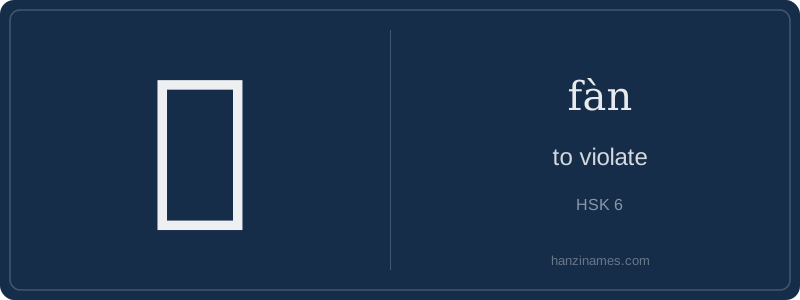
In modern Chinese, 犯 appears ubiquitously in legal, ethical, and everyday contexts: ‘犯罪’ (fànzuì, ‘to commit a crime’) is central to news reports and judicial discourse; ‘犯规’ (fànguī, ‘to violate a rule’) is used in sports, education, and workplace regulations. A well-documented idiom is ‘明知故犯’ (míngzhī gù fàn, ‘to knowingly violate’), frequently cited in anti-corruption campaigns since the 2010s—appearing in official Xinhua News Agency releases and CPC disciplinary documents.
The character’s earliest attested form appears in bronze inscriptions of the Western Zhou (c. 1046–771 BCE), where it combined 犭 (a variant of 犬, ‘dog’) and 范 (fàn, ‘mold, pattern’—later simplified to 㔾). It originally conveyed ‘acting outside the mold’, i.e., deviating from established norms. No oracle bone form survives, but its bronze-era usage confirms its ancient association with normative order.
The character 犯 (fàn) embodies a profound cultural understanding of boundaries—not just legal ones, but moral, social, and cosmic limits. In traditional Chinese thought, harmony arises from adherence to ritual (lǐ), law (fǎ), and natural order (dào). To ‘violate’ is not merely to break a rule, but to disturb the delicate equilibrium between self and society, human and heaven. This reflects Confucian emphasis on responsibility and Daoist reverence for natural alignment.
Unlike Western notions where ‘violation’ often centers on individual rights, 犯 carries collective weight: one’s transgression ripples through family reputation, community trust, and even ancestral honor. The radical 犭 (‘dog’ or ‘beast’) hints at primal impulses—suggesting that violation stems not from malice alone, but from unchecked instinct overriding cultivated virtue (dé). Thus, self-cultivation is preventive medicine against ‘fàn’.
This worldview treats law not as abstract statute, but as living expression of shared values. Even today, phrases like ‘犯错误’ (fàn cuòwù, ‘to make a mistake’) soften accountability with humility—framing error as a lapse in cultivation, not inherent guilt. Such linguistic gentleness reveals a culture prioritizing reform over condemnation, restoration over retribution—a quiet testament to resilience rooted in relational ethics.
Example Sentences
Common Compounds
Similar Characters — Don't Mix These Up
Your First Step into Chinese Culture: Get a Chinese Name
Every journey into Chinese begins with a name. Use our free Chinese name generator to create a meaningful, personalized Chinese name that fits you perfectly.
Get My Chinese Name →