狼
Character Story & Explanation
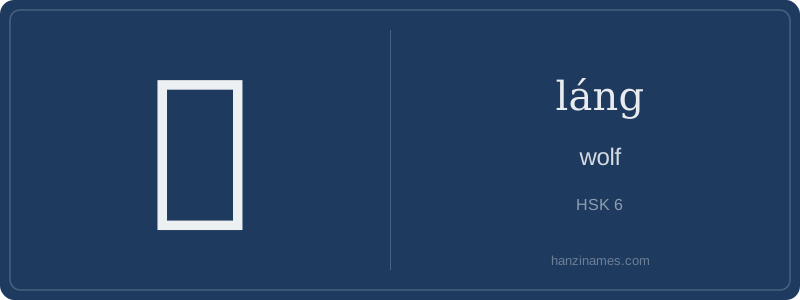
In modern Chinese, 狼 appears most frequently in idioms and metaphorical expressions—not zoology texts. The idiom 狼吞虎咽 (láng tūn hǔ yàn, 'wolf-devouring, tiger-gulping') vividly describes ravenous eating and is widely used in daily speech and textbooks. Historically, wolves symbolized danger and cunning in classical texts like the *Zuo Zhuan*, but unlike Western folklore, Chinese tradition rarely personifies wolves as villains; instead, they’re neutral ecological presences—evident in regional names like Inner Mongolia’s Wolf Mountain (狼山).
The character’s form has no verified oracle-bone pictograph. Its earliest confirmed appearance is in Warring States bamboo slips (475–221 BCE) as a standardized semantic-phonetic compound. Today, Chinese learners encounter it first in idioms or compound words like 狼狗 (lánggǒu, 'German Shepherd')—a practical, high-frequency usage tied to real-life pets and security animals.
As a linguistic detective, I begin at the scene: the modern character 狗 (dog) and 狼 (wolf) share the same radical—犭, the ‘beast’ or ‘quadruped’ radical—telling us instantly this character belongs to the animal kingdom. The right side, 朗 (lǎng), is a phonetic component, originally meaning 'bright' or 'clear', but here it serves primarily to signal pronunciation (láng). This is a classic left-radical/right-phonetic structure common in ~80% of Chinese characters.
Zooming into history, 狼 appears in bronze inscriptions from the late Shang and early Zhou dynasties—not as a pictograph of a howling wolf, but as a semantic-phonetic compound already stabilized. Unlike older characters like 日 (sun) or 山 (mountain), 狼 never evolved from a clear pictorial form; its earliest attested forms show the beast radical paired with variants of 朗 or 良, confirming its phonetic-driven origin rather than visual mimicry.
The radical 犭 itself is a cursive simplification of 犬 (quǎn, 'dog'), reflecting how Chinese script evolved toward efficiency. So 狼 isn’t just ‘wolf’—it’s a forensic artifact of linguistic economy: a canine classifier + a sound cue. Its 10-stroke count includes three precise hook-and-flick strokes in the radical (the 'claws' of the beast), followed by seven balanced strokes in 朗—making stroke order crucial for legibility and authenticity in both calligraphy and HSK writing exams.
Example Sentences
Common Compounds
Similar Characters — Don't Mix These Up
Your First Step into Chinese Culture: Get a Chinese Name
Every journey into Chinese begins with a name. Use our free Chinese name generator to create a meaningful, personalized Chinese name that fits you perfectly.
Get My Chinese Name →