珠
Character Story & Explanation
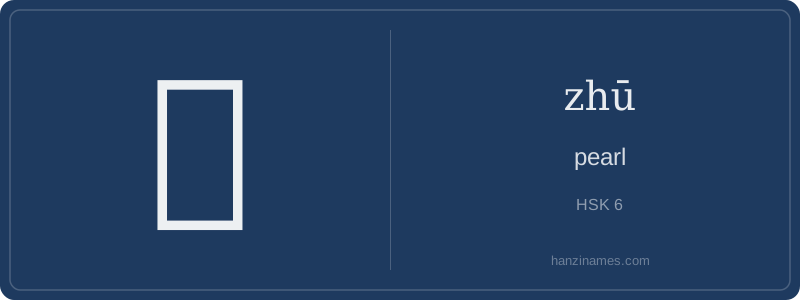
In daily life, 珠 appears in ubiquitous compounds: 珍珠 (zhēnzhū, 'pearl'), 珠宝 (zhūbǎo, 'jewelry'), and idioms like 字字珠玑 (zì zì zhū jī)—'every word a pearl and a grain of millet,' meaning exceptionally refined language. Historically, it was central to tributary records: the Han Shu (1st c. CE) documents southern Yue states presenting ‘white pearls’ to the imperial court as diplomatic tokens.
The character’s form is not pictographic but phono-semantic: left radical 王 (wáng, ‘jade/king’, indicating preciousness); right phonetic 朱 (zhū, ‘vermilion’, providing sound and subtle color connotation). No oracle-bone inscriptions of 珠 survive; its earliest attestation is in Warring States bronze inscriptions (4th c. BCE), where it consistently denotes spherical, valued objects—not abstract concepts.
Unearthing the character 珠 feels like brushing dust from a Han dynasty jade bead—smooth, luminous, and charged with layered meaning. Its radical 王 (‘king’) signals preciousness, not royalty: in ancient China, jade and pearls were royal-grade treasures, symbolizing purity and moral luster. The right-hand component 朱 (zhū, 'vermilion') originally evoked the vivid red of cinnabar-lacquered beads used in ritual ornaments—color as consecration.
This character emerged fully formed in seal script (c. 3rd century BCE), already encoding value beyond mere ornamentation. Unlike generic ‘bead’ characters like 珮 (pèi, decorative pendant), 珠 specifically denotes round, polished, naturally luminous objects—pearls first, then extended to glass, jade, or even metaphorical ‘gems’ of wisdom. Its phonetic-semantic structure is remarkably stable: no major glyphic shifts across 2,200 years.
Archaeological finds confirm its semantic weight: bamboo slips from Mawangdui (2nd c. BCE) use 珠 to denote tribute items—‘ten strings of pearls’ recorded alongside silk and bronze mirrors. Later Tang poetry (e.g., Li Bai) deploys 珠 metaphorically—‘tears like pearls’—proving its dual role as concrete artifact and poetic cipher for transient beauty. This duality persists today: a modern Chinese speaker sees both a physical bead and an intangible jewel of meaning.
Example Sentences
Common Compounds
Similar Characters — Don't Mix These Up
Your First Step into Chinese Culture: Get a Chinese Name
Every journey into Chinese begins with a name. Use our free Chinese name generator to create a meaningful, personalized Chinese name that fits you perfectly.
Get My Chinese Name →