瓦
Character Story & Explanation
In daily life, 瓦 appears in construction terminology (e.g., 瓦工 wǎgōng, 'tile-layer'), heritage restoration reports, and common phrases like ‘添砖加瓦’ (tiān zhuān jiā wǎ), meaning 'to contribute one’s share to a collective effort'—a Confucian ideal rooted in tangible community labor. Historically, standardized ceramic roof tiles were mandated under the Qin and Han dynasties; excavated Warring States tiles bear inscriptions identifying workshops and supervisors—proof of early state quality control.
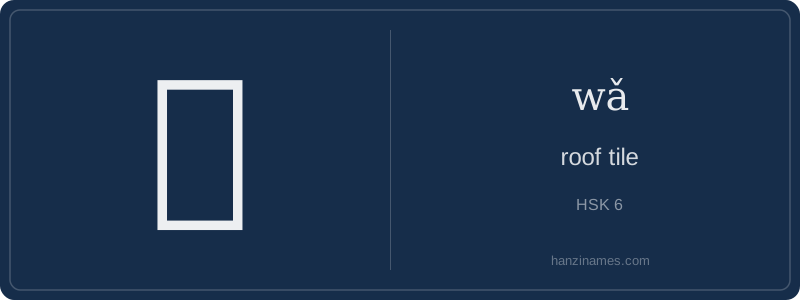
The character 瓦 is a documented pictograph: bronze inscriptions from the Western Zhou show a clear side-view silhouette of a curved tile resting on rafters—arched top stroke representing the convex surface, lower horizontal stroke the supporting beam or ridge. Its shape has remained remarkably stable for over 2,500 years.
Imagine walking through Pingyao Ancient City in Shanxi Province at dawn—the cobblestone lanes glisten with dew, and the low, curved roofs of Ming-dynasty courtyard houses glow amber under soft light. Each roof is layered with grey-brown ceramic tiles: smooth on top, concave underneath, interlocking like scales. These are 瓦 (wǎ)—not just building materials, but quiet witnesses to over 3,000 years of Chinese architecture, from Zhou dynasty palaces to today’s restored heritage homes.
The character 瓦 itself is a masterclass in minimalist representation: its four strokes capture the side profile of a half-cylindrical tile—arched curve above, flat base below, with subtle angularity suggesting craftsmanship and weight. Unlike abstract radicals, 瓦 remains one of the few characters that still functions as both a semantic radical *and* an independent, frequently used word—its form unchanged since seal script, testifying to continuity in material culture across millennia.
In modern China, 瓦 appears far beyond rooftops: it’s embedded in idioms like ‘破瓦寒窑’ (pò wǎ hán yáo), evoking humble yet dignified resilience, and surfaces in conservation efforts—like Beijing’s hutong renovation projects where reclaimed antique tiles are cataloged by kiln origin and dynasty. Even tech startups use 瓦 metaphorically: ‘云瓦’ (yún wǎ, ‘cloud tile’) names modular data-center units, honoring tradition while scaling innovation—a literal and symbolic roof for the digital age.
Example Sentences
Common Compounds
Similar Characters — Don't Mix These Up
Your First Step into Chinese Culture: Get a Chinese Name
Every journey into Chinese begins with a name. Use our free Chinese name generator to create a meaningful, personalized Chinese name that fits you perfectly.
Get My Chinese Name →