甭
Character Story & Explanation
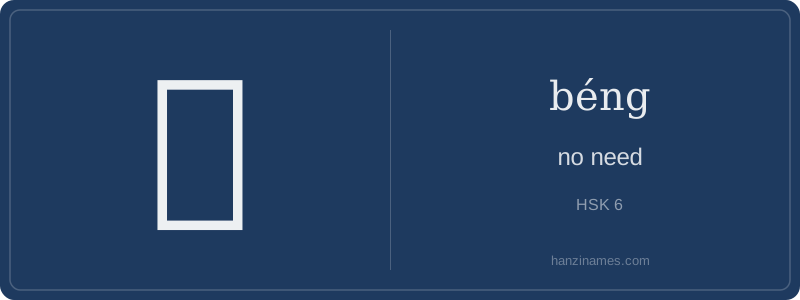
甭 is overwhelmingly used in Northern Mandarin speech and informal writing—especially in Beijing opera scripts, Lao She’s novels (e.g., Teahouse), and modern sitcoms—to convey relaxed, no-nonsense refusal. It’s absent from formal registers, legal texts, or news broadcasts. Real-world usage peaks in imperative or dismissive contexts: '甭客气' (don’t bother being polite) or '甭费劲了' (don’t waste effort). No idioms feature it, but it appears in fixed conversational formulas documented in the Modern Chinese Dictionary (7th ed., 2016) as a standard colloquial contraction.
The character has no pictographic origin—it’s a phono-semantic compound created in the Ming–Qing transition. Its form merges 不 (not) above 用 (use) to signal 'not-use', but the fusion is graphic shorthand, not historical derivation. Today, Beijing taxi drivers, street vendors, and sitcom writers use 甭 dozens of times daily—always orally first, then written informally to capture authentic speech rhythm.
As a linguistic detective, I trace 甭 not to ancient inscriptions—but to the bustling alleys of late imperial Beijing. This character doesn’t appear in oracle bones or bronze scripts; it emerged organically in spoken Mandarin as a rapid contraction of 不用 (bù yòng, 'don’t need to'). Its creation reflects a universal phonetic tendency: speakers slurring common two-syllable phrases into single, efficient syllables—much like English 'gonna' from 'going to'. The fusion wasn’t formalized until the Qing dynasty’s vernacular literature, where scribes began writing the sound 'béng' with a character combining 不 and 用.
The radical 用 (yòng, 'to use') anchors 甭 semantically—its meaning hinges on negating utility. The top component is a stylized, cursive-influenced 不 (bù, 'not'), fused so tightly that the dot and stroke merge visually. Though listed as 9 strokes, its handwritten form often blurs boundaries, revealing how orthography follows speech—not the reverse. This makes 甭 a rare case where a character was *born* from pronunciation, then retrofitted into the writing system.
Its dual pronunciation—béng (standard) and bèng (regional/stressed)—mirrors dialectal variation in northern Mandarin. In Hebei and Tianjin, the falling tone (bèng) adds emphasis, almost mimicking an emphatic shrug. Linguists note that 甭 never appears in classical texts or formal documents; it lives exclusively in dialogue, drama, and colloquial writing. Its survival proves that Chinese script accommodates spoken innovation—even when it breaks traditional morphemic rules—making 甭 a living fossil of everyday language evolution.
Example Sentences
Common Compounds
Similar Characters — Don't Mix These Up
Your First Step into Chinese Culture: Get a Chinese Name
Every journey into Chinese begins with a name. Use our free Chinese name generator to create a meaningful, personalized Chinese name that fits you perfectly.
Get My Chinese Name →