畏
Character Story & Explanation
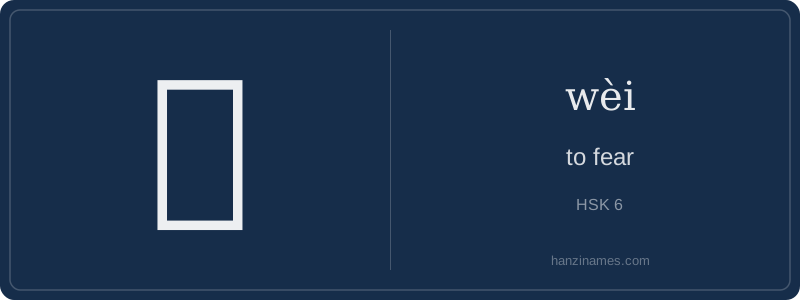
畏 appears frequently in formal, literary, and philosophical contexts—not in casual speech—but remains vital in idioms like 敬而远之 (jìng ér yuǎn zhī, 'respect but keep at a distance') and in classical phrases such as 畏天命 (wèi tiānmìng, 'fear Heaven’s mandate'), cited in the *Analects*. It is standard in HSK 6 vocabulary lists and appears in official exam reading passages discussing ethics or historical governance.
The character’s form evolved from seal script, where the upper part (甶) originally depicted a skull-like face (a variant of 鬼, 'ghost'), symbolizing awe-inspiring dread, while the lower 田 (field/radical) may have been phonetic rather than semantic. Modern scholarship (e.g., *Chinese Etymological Dictionary* by Li Xiaoding) confirms 甶 as the semantic component conveying 'dread,' not 田—making this a rare case where the designated radical (田) is actually non-semantic.
The character 畏 (wèi) embodies a profound dimension of the Chinese worldview: fear not as weakness, but as reverence—rooted in humility before moral order, natural forces, and social hierarchy. In Confucian thought, ‘fearing the Mandate of Heaven’ (畏天命) signifies ethical awareness, not superstition; it reflects an understanding that human conduct must align with cosmic and societal harmony. This nuanced fear cultivates self-discipline and responsibility.
Unlike Western dualisms that often oppose fear and courage, classical Chinese philosophy treats 畏 as foundational to virtue. The *Analects* (16.8) states, ‘The superior person has three things he fears,’ listing Heaven’s will, great men, and the words of sages—linking fear directly to moral cultivation. Here, fear is pedagogical: it restrains excess and guides reflection, making it essential for self-cultivation and good governance.
This character reveals how traditional Chinese ethics embed emotional responses within relational ontology—where one’s inner state is inseparable from duty toward heaven, ancestors, elders, and community. 畏 thus marks a threshold between ignorance and wisdom: to ‘fear’ rightly is to recognize limits, honor interdependence, and act with conscious restraint. Its enduring presence in classical texts and modern idioms attests to its role as a quiet compass in China’s moral landscape.
Example Sentences
Common Compounds
Similar Characters — Don't Mix These Up
Your First Step into Chinese Culture: Get a Chinese Name
Every journey into Chinese begins with a name. Use our free Chinese name generator to create a meaningful, personalized Chinese name that fits you perfectly.
Get My Chinese Name →