异
Character Story & Explanation
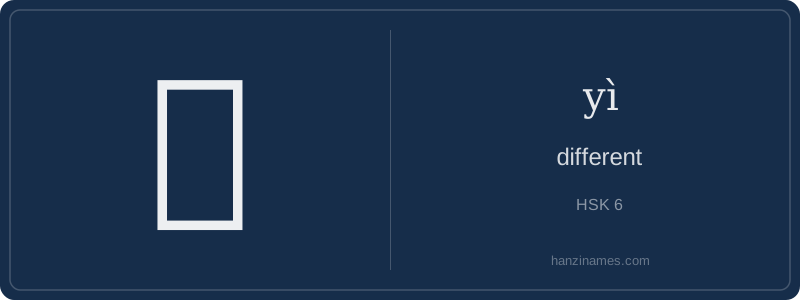
异 is widely used in modern Standard Chinese across formal and colloquial registers: in media headlines (如‘文化差异’), policy documents (‘异地就医’—cross-regional medical insurance), and everyday speech (‘好奇怪,这味道好异!’). It appears in high-frequency idioms like 求同存异 (seek common ground while reserving differences)—a cornerstone diplomatic phrase adopted by China’s foreign ministry since the 1955 Bandung Conference. The term also anchors legal concepts like 异议 (objection), used in court procedures and administrative appeals.
The character’s earliest attested form appears in Warring States bamboo slips (4th c. BCE) as a compound of 廾 (a pair of hands holding up) and another element now lost; by Han dynasty seal script, it standardized with 廾 + 田 + 共 variants. While its exact oracle-bone origin remains unattested, scholars agree the modern structure (廾 + 巳) evolved phonetically—巳 (sì) provided sound, while 廾 signaled ritual distinction. Today, Chinese learners practice it early in HSK 6 prep for its role in abstract, cross-cultural vocabulary.
The character 异 (yì) embodies a foundational Chinese philosophical stance: difference is not deviation, but natural variation within unity. Rooted in classical texts like the Yijing (Book of Changes), it reflects the Daoist and Confucian understanding that harmony arises not from uniformity, but from respectful coexistence of distinct elements—like wind and rain, mountain and river, or scholar and artisan. This worldview rejects binary oppositions; instead, ‘difference’ is relational, contextual, and generative.
In Chinese cosmology, 异 signals dynamic balance: the ‘other’ is essential for self-definition—just as yin defines yang. It appears in key terms like 异端 (heresy), not as mere rejection, but as ideas outside orthodox frameworks yet historically prompting reform and renewal. Even in governance, ‘different customs’ (风土各异) were acknowledged by imperial administrators to tailor policies regionally—a pragmatic pluralism centuries before modern multicultural theory.
This character subtly challenges Western individualism’s emphasis on uniqueness as self-assertion. In Chinese usage, 异 rarely stands alone as ‘I am different’; rather, it functions relationally—‘different from’, ‘differing in’, ‘distinctive due to context’. Its quiet humility mirrors the Confucian ideal: identity emerges through roles, responsibilities, and responsive adaptation—not fixed traits. Thus, 异 invites us to see diversity not as fragmentation, but as the very texture of coherence.
Example Sentences
Common Compounds
Similar Characters — Don't Mix These Up
Your First Step into Chinese Culture: Get a Chinese Name
Every journey into Chinese begins with a name. Use our free Chinese name generator to create a meaningful, personalized Chinese name that fits you perfectly.
Get My Chinese Name →