疙
Character Story & Explanation
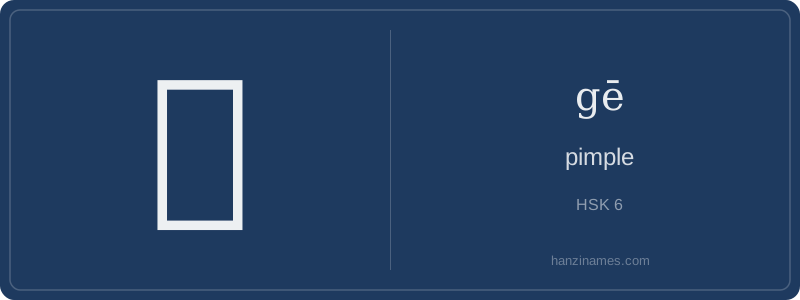
In modern Chinese, 疙 appears almost exclusively in compound words—not alone—and overwhelmingly in northern Mandarin dialects and literary depictions of rural life. It’s central to fixed expressions like 疙瘩 (gēda, 'lump' or 'knot', both literal and metaphorical), famously used in phrases such as '心里有个疙瘩' ('there’s a knot in one’s heart') to express unresolved emotional tension. The term is documented in 19th-century vernacular novels like Officialdom Unmasked (《官场现形记》) and remains common in CCTV documentaries about traditional medicine.
The character is not pictographic nor ancient: it first appears in Song–Yuan period rhyme dictionaries as a phonosemantic compound. Its form combines 疒 (sickness radical) + 可 (phonetic, kě → gē via historical sound shift). No oracle bone or bronze inscription contains it—its origin is purely medieval vernacular script, born from speech, not ritual.
As an archaeologist sifting through layers of linguistic sediment, I uncover 疙 not in oracle bones—but in Ming dynasty medical manuscripts and Qing vernacular fiction, where it surfaces as a colloquial yet precise term for small, raised skin lesions. Its radical 疒 (‘sickness’) anchors it firmly in the lexicon of bodily affliction, while the phonetic component 可 (kě) offers pronunciation guidance—not meaning. This is no abstract glyph: it’s a diagnostic shorthand etched into centuries of folk medicine texts.
The character’s eight strokes form a compact, top-heavy structure: the ‘sickness’ radical crowns the character like a canopy over the body, while 可 beneath suggests both sound and a subtle implication of ‘possible’ or ‘manifest’—as if the pimple is a visible, inevitable eruption. Unlike classical characters born of ritual bronze inscriptions, 疙 emerged from spoken language, later codified—a rare case of vernacular speech fossilizing into script.
Its HSK Level 6 status reflects not complexity of form but semantic specificity: it denotes a *type* of skin anomaly—neither boil nor rash nor cyst—but a small, firm, often painless bump. Modern dermatology textbooks still use it alongside clinical terms, revealing how traditional lexical precision endures. In dialectal usage across northern China, 疙 carries tactile nuance—evoking texture, lumpiness—making it indispensable in descriptive realism, from rural storytelling to contemporary novels.
Example Sentences
Common Compounds
Similar Characters — Don't Mix These Up
Your First Step into Chinese Culture: Get a Chinese Name
Every journey into Chinese begins with a name. Use our free Chinese name generator to create a meaningful, personalized Chinese name that fits you perfectly.
Get My Chinese Name →