症
Character Story & Explanation
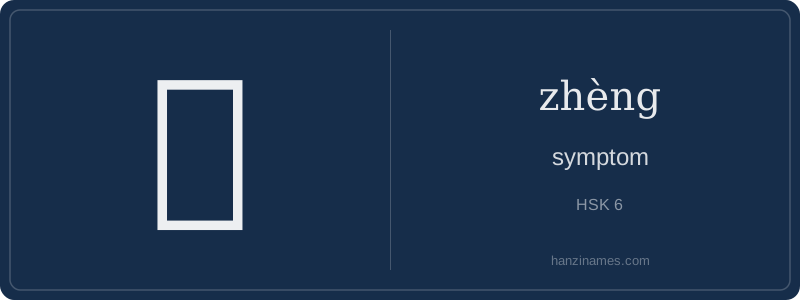
症 is ubiquitous in modern Chinese medical communication: used daily in clinical notes (e.g., 主要症状, 'chief complaint'), public health advisories (e.g., 新冠典型症状, 'typical COVID-19 symptoms'), and widely recognized phrases like 对症下药 (duì zhèng xià yào, 'treat according to symptoms'), an idiom from the Song dynasty physician Qian Yi’s *Key to Therapeutics*, still taught in TCM curricula today. It appears in official WHO-China joint reports and national screening guidelines.
The character evolved from seal script (c. 3rd century BCE), where 疒 (sickness radical) + 正 (zhèng, 'correct/standard') conveyed 'standardized manifestations'—not 'correct disease', but 'recognized, normative signs'. This reflects early systematic symptom cataloging in Han dynasty medical texts like the *Huangdi Neijing*, where symptoms were classified by yin-yang and organ correlations—not as random events, but as intelligible patterns.
The character 症 (zhèng) embodies the Chinese worldview that illness is not merely a physical malfunction but a visible manifestation—'a sign'—of imbalance within the body’s holistic system. Rooted in Traditional Chinese Medicine (TCM), it reflects the belief that symptoms (症) are communicative signals, not just problems to suppress. This aligns with the classical distinction between 'disease entity' (病, bìng) and 'manifesting signs/symptoms' (症, zhèng), where diagnosis hinges on pattern recognition rather than isolated pathology.
Historically, the dual pronunciation—zhèng (standard modern usage) and zhēng (archaic, now mostly in fixed terms like 癥 (zhēng), meaning 'hard mass disease')—mirrors linguistic stratification: zhèng denotes observable, dynamic manifestations (e.g., fever, cough), while zhēng survives in classical medical texts describing stubborn, congealed pathologies. This phonetic duality reveals how language preserves layers of medical epistemology across dynasties.
In contemporary China, 症 retains its diagnostic gravity: doctors document ‘symptom profiles’ (症状, zhèngzhuàng), and public health campaigns emphasize early symptom awareness (如发热、干咳等早期症状). Its radical 疒 (nè), meaning 'sickness', visually anchors it in the lexicon of care—appearing in over 50 illness-related characters. Thus, 症 is not passive 'disease' but active, interpretive evidence—a cultural lens through which health is read, not just measured.
Example Sentences
Common Compounds
Similar Characters — Don't Mix These Up
Your First Step into Chinese Culture: Get a Chinese Name
Every journey into Chinese begins with a name. Use our free Chinese name generator to create a meaningful, personalized Chinese name that fits you perfectly.
Get My Chinese Name →