瘩
Character Story & Explanation
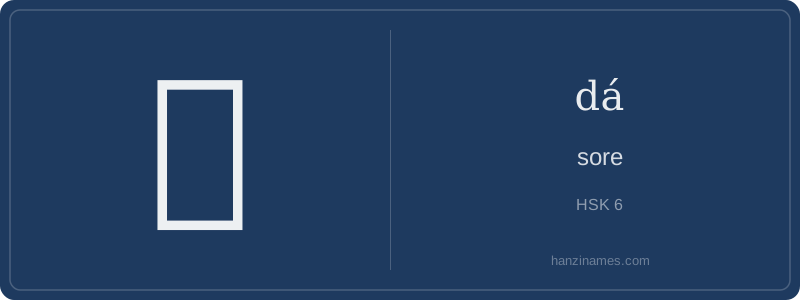
瘩 is rarely used alone in modern Standard Mandarin; it appears almost exclusively in fixed compounds like 疙瘩 (gēda), meaning 'lump', 'knot', or figuratively 'mental block'. Historically, it appears in classical medical texts such as the Bencao Gangmu (1596), where 瘩 refers to superficial suppurative lesions treated with detoxifying herbs. In contemporary usage, it survives mainly in northern dialects and oral expressions—e.g., '起瘩' (qǐ dá, 'to break out in sores')—though even there, it's largely superseded by terms like 疮 (chuāng) or 痈 (yōng).
The character’s form combines the 'sickness' radical 疒 (nè) — indicating illness-related semantics — with the phonetic component 大 (dà, 'big'), suggesting both sound approximation and visual metaphor: a swollen, prominent lesion. This structure aligns with standard phono-semantic compound formation documented in the Shuōwén Jiězì (121 CE), where 大 serves strictly as a phonetic cue, not a semantic one.
The Chinese character 瘩 (dá) denotes a localized skin sore, boil, or abscess—often implying inflammation, swelling, and discomfort. Unlike the broad English term 'sore', which covers everything from mouth ulcers to muscle aches, 瘩 specifically refers to a raised, tender, pus-filled lesion on the skin. It carries a clinical yet colloquial tone, appearing more in traditional medicine contexts or regional speech than in formal biomedical reports.
In Western medical culture, equivalents include 'boil', 'furuncle', or 'carbuncle'—terms rooted in Latin/Greek taxonomy and precise anatomical description. By contrast, 瘩 reflects a holistic, symptom-based tradition: it’s not classified by bacterial cause (e.g., Staphylococcus) but by outward appearance and bodily imbalance (e.g., 'heat toxin' in TCM). This mirrors how many Chinese medical terms prioritize pattern recognition over pathogen identification.
Culturally, calling something a 瘩 evokes visceral familiarity—especially among older generations or rural communities where home remedies (e.g., warm compresses, herbal poultices) are still common first responses. While Western patients might immediately seek antibiotics, a 瘩 is often initially managed with patience and topical care, reflecting deeper cultural attitudes toward minor acute conditions as self-limiting and body-integrated rather than purely pathological.
Example Sentences
Common Compounds
Similar Characters — Don't Mix These Up
Your First Step into Chinese Culture: Get a Chinese Name
Every journey into Chinese begins with a name. Use our free Chinese name generator to create a meaningful, personalized Chinese name that fits you perfectly.
Get My Chinese Name →