瘫
Character Story & Explanation
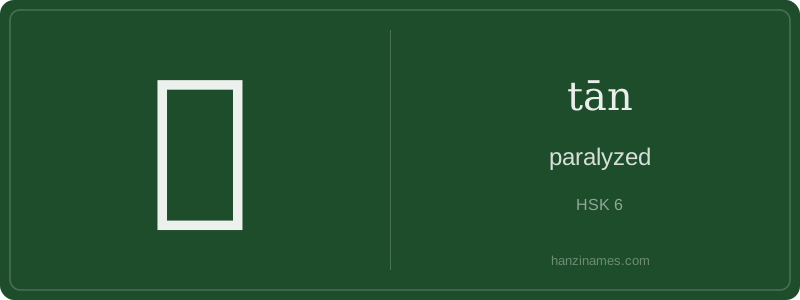
瘫 is widely used in medical contexts (e.g., 脑卒中后偏瘫 — hemiplegia post-stroke) and colloquially to express total functional breakdown: ‘服务器瘫了’ (the server crashed), ‘我累瘫了’ (I’m utterly drained). It appears in HSK 6 vocabulary lists and is frequent in news reports about infrastructure failure or public health crises. The idiom ‘瘫软无力’ (tān ruǎn wú lì) describes physical or moral collapse—used historically in 20th-century political discourse to criticize bureaucratic lethargy.
The character first appeared in seal script (c. 3rd century BCE), combining 疒 (illness radical) with 坦 (tǎn, originally meaning ‘flat ground’). While not a pictograph, its structure reflects early diagnostic logic: paralysis manifests as loss of upright posture—hence ‘sickness + flatness’. No oracle bone form exists; earliest verified use is in Han dynasty medical texts like the *Huangdi Neijing*, describing ‘wind-damp paralysis’ (风瘫).
The character 瘫 (tān) embodies a profound Chinese cultural sensitivity to the body as an integrated system—where physical collapse reflects deeper imbalances in qi, emotion, or social harmony. Unlike Western biomedical isolation of 'paralysis' as neurological failure, traditional Chinese thought links 瘫 to stagnation (yūn), dampness (shī), or wind (fēng) invading the channels—revealing a worldview where health is relational, dynamic, and inseparable from environment and spirit.
Its radical 疒 (‘sickness’) signals illness, but the right side 坦 (tǎn, ‘flat, open, unobstructed’) ironically contrasts with its meaning: true ‘openness’ here is pathological—limbs unnaturally flattened, will unmoored, function collapsed. This duality mirrors classical Chinese medicine’s emphasis on *flow*: when qi and blood cease moving, the body ‘flattens’ into helplessness—a metaphor extended socially to describe institutions or economies losing vitality.
In modern usage, 瘫 carries layered connotations beyond clinical paralysis—evoking emotional overwhelm (‘my brain is paralyzed’), systemic inertia (‘bureaucracy has瘫ed’), or digital exhaustion (‘my phone battery is瘫ed’). This semantic expansion reveals a cultural truth: the Chinese language treats incapacity not as static condition, but as a *process of unraveling*—a vivid linguistic register for vulnerability, fragility, and the quiet crisis of disconnection in rapid modernity.
Example Sentences
Common Compounds
Similar Characters — Don't Mix These Up
Your First Step into Chinese Culture: Get a Chinese Name
Every journey into Chinese begins with a name. Use our free Chinese name generator to create a meaningful, personalized Chinese name that fits you perfectly.
Get My Chinese Name →