眶
Character Story & Explanation
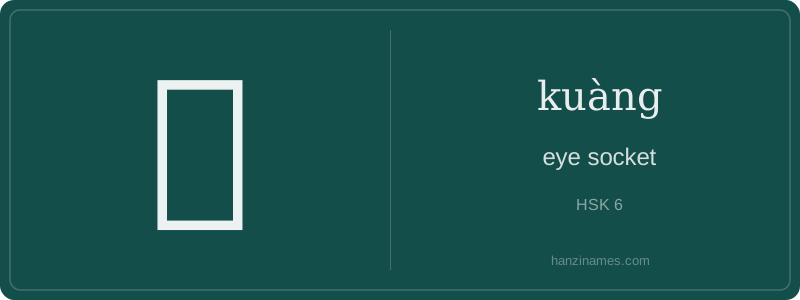
眶 is commonly used in modern Chinese medical terminology (e.g., 眶内肿瘤, 'intraorbital tumor') and in emotionally charged expressions like 热泪盈眶 ('tears brim over the eye sockets'), widely featured in speeches, documentaries, and patriotic literature since the 1950s. It appears in standardized medical texts such as the 《中华人民共和国国家标准·人体解剖学术语》 (2014) and is required vocabulary for HSK 6 due to its role in advanced descriptive and literary language.
As a phono-semantic compound, 眶 combines the 目 (mù, 'eye') radical with the phonetic component 匡 (kuāng, meaning 'to correct/contain'). Its earliest attested form appears in Han dynasty bamboo slips, already bearing the current structure—indicating stable orthography for over 2,000 years. No oracle bone or bronze script forms survive, confirming its later emergence in the written system.
The Chinese character 眶 (kuàng) refers specifically to the bony cavity surrounding the eye—the anatomical eye socket. Unlike English, which often uses 'eye socket' only in medical or forensic contexts, 眶 appears in both clinical and literary registers in Chinese, carrying subtle connotations of vulnerability, emotion, and physical boundary—especially when describing tears welling 'to the rim of the eye socket' (热泪盈眶). Its precision reflects traditional Chinese medicine’s holistic view of the eye as an interface between inner vitality (qi) and external world.
In Western anatomy, 'orbit' is the technical term for the eye socket, but it rarely appears outside textbooks; 'eye socket' itself is informal and seldom evokes imagery beyond structure. By contrast, 眶 frequently appears in emotive idioms (e.g., 热泪盈眶), where the socket becomes a vessel for overwhelming feeling—suggesting cultural emphasis on embodied emotion rather than detached observation. This mirrors broader East Asian tendencies to locate affect in physical thresholds and boundaries.
While English speakers might say 'tears welled up in her eyes', Chinese specifies *where* they accumulate: not just in the eyes, but *at the rim of the socket*. This spatial specificity matters—it implies containment, overflow, and physiological authenticity. In poetry and film subtitles, 眶 reinforces sincerity: tears that reach the 眶 are deemed genuine, unfeigned. Such linguistic granularity supports HSK 6 learners’ shift from functional fluency to stylistic nuance and culturally grounded expression.
Example Sentences
Common Compounds
Similar Characters — Don't Mix These Up
Your First Step into Chinese Culture: Get a Chinese Name
Every journey into Chinese begins with a name. Use our free Chinese name generator to create a meaningful, personalized Chinese name that fits you perfectly.
Get My Chinese Name →