睬
Character Story & Explanation
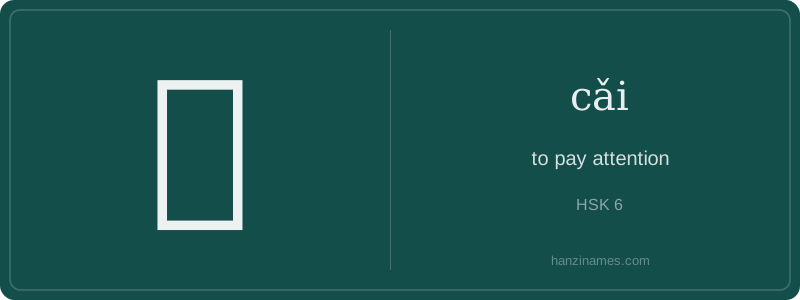
In modern Mandarin, 睬 is overwhelmingly used in the phrase 不睬 (bù cǎi), meaning 'to ignore' or 'to pay no attention to'. It appears frequently in literature (e.g., Lu Xun’s works), film subtitles, and everyday speech—especially when describing deliberate social snubbing. The idiom 爱理不理 (ài lǐ bù lǐ), meaning 'indifferently responsive', also features 睬’s variant form 理 (lǐ), historically linked through semantic overlap in 'attending to'. Documented usage dates to at least the Qing dynasty in vernacular novels like Officialdom Unmasked.
The character 睬 is a phono-semantic compound: 目 (mù, 'eye') as the semantic radical indicates its connection to perception and visual attention, while 采 (cǎi, 'to gather, pluck') serves as the phonetic component. There is no oracle-bone or bronze inscription evidence for 睬—it first appears in later clerical script texts. Its form reflects how classical Chinese extended meanings of 'gathering' (采) into 'gathering attention'—a natural semantic shift grounded in observable behavior.
Imagine walking through Beijing’s bustling Nanluoguxiang alley on a rainy afternoon. A street vendor calls out, but a young woman in headphones keeps scrolling—her eyes fixed on her phone, not glancing up once. Her friend gently taps her shoulder and says, '别睬他!' (Don’t pay attention to him!). Here, 睬 isn’t about hearing—it’s about the conscious choice to *acknowledge* or *ignore*, rooted in gaze and intention. Its radical 目 (eye) signals that attention begins with visual recognition—and often ends there.
The character 睬 carries subtle social weight. In Chinese communication, deliberately refusing to ‘cǎi’ someone—by withholding eye contact, silence, or turning away—is a quiet but potent act of dismissal. Unlike outright rudeness, it’s culturally coded: no words needed, just the absence of visual engagement. This makes 睬 uniquely interpersonal—not merely cognitive attention, but *relational* attention, tied to face-to-face presence and mutual acknowledgment.
HSK Level 6 learners encounter 睬 not as a standalone verb, but almost exclusively in negative constructions like 不睬 or 爱理不理 (‘half-heartedly acknowledge’). It rarely appears in formal writing or news; instead, it thrives in dialogue, fiction, and spoken registers where emotional nuance matters. Mastering 睬 means grasping how Chinese speakers encode indifference—not through vocabulary of coldness, but through the deliberate withdrawal of the most basic social gesture: looking back.
Example Sentences
Common Compounds
Similar Characters — Don't Mix These Up
Your First Step into Chinese Culture: Get a Chinese Name
Every journey into Chinese begins with a name. Use our free Chinese name generator to create a meaningful, personalized Chinese name that fits you perfectly.
Get My Chinese Name →