瞄
Character Story & Explanation
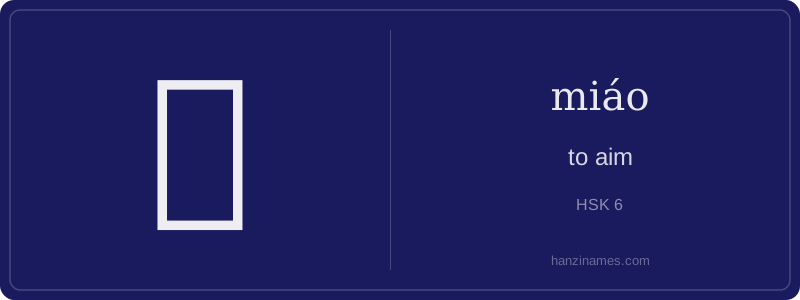
瞄 is widely used in modern Chinese media, military training manuals, and sports commentary—especially in archery, shooting, and air rifle competitions governed by the Chinese Shooting Association. It appears in standardized phrases like 瞄准镜 (miáozhǔnjìng, 'telescopic sight') and the idiom 瞄准目标,稳步前进 ('aim at the goal, advance steadily'), a slogan adopted in national development planning documents since the 2010s. The People's Liberation Army’s official training guides consistently use 瞄 to describe sight alignment procedures.
The character combines 目 (mù, 'eye', radical #109) and 苗 (miáo, 'seedling', phonetic component). It is a phono-semantic compound (形声字), first reliably attested in Ming-dynasty texts like the 1573 *Jiǎo Zhèn Tú* (Illustrated Manual of Battle Arrays), where it described archers adjusting their aim. No oracle bone or bronze script forms exist—it emerged later as a specialized term for precision sighting.
The Chinese character 瞄 (miáo) literally means 'to take aim'—a precise, intentional act of aligning one’s gaze with a target before action. Unlike general verbs for 'look' or 'see', 瞄 emphasizes focused visual targeting, often with implied preparation for shooting, pointing, or decisive action. Its meaning bridges physical sight and strategic intent, making it common in military, sports, and metaphorical contexts.
In English, no single verb captures its nuance: 'aim' is closest but lacks the visual component; 'peer' or 'gaze' lack intentionality; 'sight' (as in 'to sight a rifle') is technical but rarely used transitively in daily speech. Western equivalents like 'lining up a shot' (golf), 'acquiring a target' (military), or 'taking careful aim' all approximate 瞄—but none compress the act of visual alignment + imminent action into one compact, everyday verb.
This semantic density reflects a broader Chinese linguistic tendency: many verbs encode both manner and purpose in a single syllable. 瞄 appears in formal writing, news reports on defense, and colloquial speech alike—e.g., 瞄准机会 ('aim at an opportunity') shows how the concept extends beyond firearms into strategy and timing. Its HSK 6 status signals that learners must grasp not just literal usage, but also this abstract, goal-oriented extension of vision.
Example Sentences
Common Compounds
Similar Characters — Don't Mix These Up
Your First Step into Chinese Culture: Get a Chinese Name
Every journey into Chinese begins with a name. Use our free Chinese name generator to create a meaningful, personalized Chinese name that fits you perfectly.
Get My Chinese Name →