瞪
Character Story & Explanation
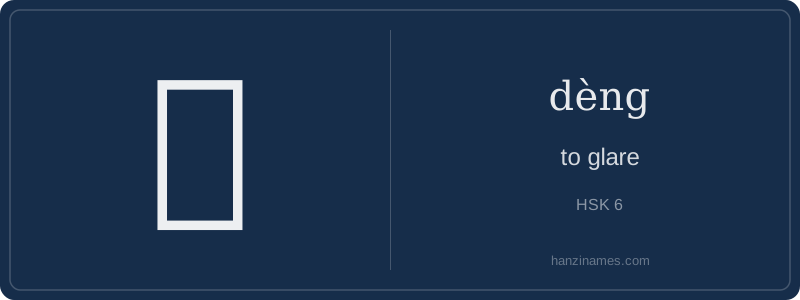
In modern Chinese, 瞪 is most commonly used in spoken and written expressions of sharp emotional reaction — especially in phrases like 瞪眼 (dèng yǎn, 'to glare'), 瞪大眼睛 (dèng dà yǎn jīng, 'to widen one’s eyes'), and the idiom 瞪目结舌 (dèng mù jié shé, 'to stare open-mouthed' — describing speechless astonishment). It appears frequently in contemporary novels, film subtitles, and online commentary to convey visceral surprise or indignation.
The character’s form is a clear semantic-phonetic compound: the left radical 目 (mù, 'eye') signals meaning, while the right component 登 (dēng, 'to ascend') provides phonetic approximation (dèng is a tone-shifted variant). This structure has been stable since the Han dynasty clerical script — no oracle-bone or bronze inscriptions exist for 瞪, as it emerged later to express a nuanced, psychologically charged action.
Imagine walking through Beijing’s bustling Wangfujing Street on a crisp autumn afternoon. A street performer suddenly balances a porcelain teacup on his nose while juggling three flaming torches. The crowd freezes — mouths slightly open, eyes wide and unblinking. That intense, involuntary widening of the eyes? That’s 瞪 (dèng). It’s not just ‘looking’ — it’s a visceral, momentary shock frozen in gaze, often signaling disbelief, anger, or awe.
This character captures a uniquely human micro-expression: the sudden dilation of pupils and stretching of eyelids when startled or confronted. Unlike neutral verbs like 看 (kàn, 'to look') or 观察 (guānchá, 'to observe'), 瞪 implies emotional charge — often negative (scolding, suspicion), but sometimes awestruck (e.g., staring at the Forbidden City’s vermilion gates for the first time). Its intensity makes it common in dialogue and descriptive writing.
Because 瞪 involves active, forceful eye movement, it’s almost always intentional — even if reflexive. You wouldn’t 瞪 at a gentle breeze, but you might 瞪 at a rude comment, a sudden traffic jam, or an absurdly overpriced dumpling on a tourist menu. It’s a culturally resonant gesture: in Chinese communication, direct eye-widening can signal moral disapproval or challenge, making 瞪 a subtle yet potent social marker in both speech and literature.
Example Sentences
Common Compounds
Similar Characters — Don't Mix These Up
Your First Step into Chinese Culture: Get a Chinese Name
Every journey into Chinese begins with a name. Use our free Chinese name generator to create a meaningful, personalized Chinese name that fits you perfectly.
Get My Chinese Name →