砸
Character Story & Explanation
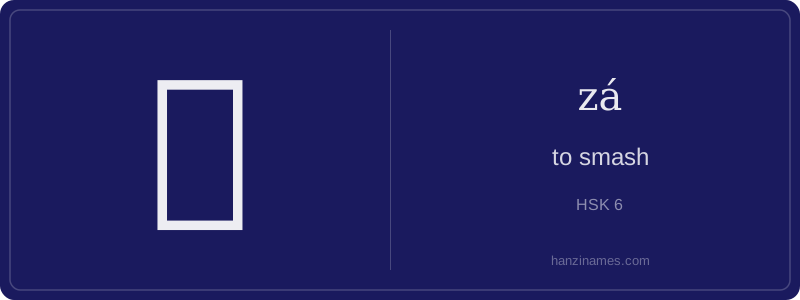
砸 is commonly used in modern Mandarin for intentional, forceful breaking or crashing—especially in spoken language and informal writing. It appears in idiomatic phrases like 砸锅卖铁 (zá guō mài tiě, 'smash the wok and sell the iron', meaning to go to extreme lengths financially) and 砸场子 (zá chǎngzi, 'smash the venue', i.e., to sabotage or embarrass someone publicly). These expressions are documented in contemporary dictionaries like the Contemporary Chinese Dictionary (7th ed., 2016) and widely attested in media and daily speech.
The character is not pictographic or ancient; it first appeared in late imperial vernacular texts and was standardized in the 20th century. Its form combines 石 (stone, radical) and 匝 (zā, phonetic component, indicating pronunciation). While 匝 originally meant 'to encircle', here it serves purely as a sound cue—no semantic link to circling. Today, Chinese speakers most commonly encounter 砸 in contexts like home renovation ('砸瓷砖' — smash floor tiles) or internet slang ('把评论区砸了' — flood the comment section).
The Chinese character 砸 (zá) conveys a forceful, often destructive action—'to smash', 'to shatter', or 'to crash down'. Unlike English verbs like 'break' or 'crush', which can be neutral or even accidental, 砸 implies deliberate, heavy impact: a hammer blow, a falling object, or an abrupt, violent interruption. Its radical 石 (stone) signals material hardness and weight, anchoring the meaning in physicality and gravity—not abstract or emotional damage, but tangible, audible destruction.
In usage, 砸 carries pragmatic and colloquial weight. It appears in construction slang ('砸墙' — to demolish a wall), tech jargon ('砸服务器' — to crash a server via overload), and even metaphorical contexts like '砸钱' (to pour money into a project aggressively). This mirrors Western idioms like 'throwing money at a problem'—but with more visceral, almost kinetic energy, evoking the sound of something heavy hitting concrete.
Culturally, 砸 resonates with Western equivalents like 'smash' (in 'smash hit' or 'smash-and-grab'), yet differs in register: while 'smash' can be celebratory ('smash your goals!'), 砸 is rarely positive unless ironically used (e.g., '砸场子' — to disrupt an event, sometimes playfully). It lacks the polished efficiency of 'demolish' or the clinical tone of 'shatter'; instead, it’s raw, noisy, and unrefined—like a brick through glass rather than a controlled implosion.
Example Sentences
Common Compounds
Similar Characters — Don't Mix These Up
Your First Step into Chinese Culture: Get a Chinese Name
Every journey into Chinese begins with a name. Use our free Chinese name generator to create a meaningful, personalized Chinese name that fits you perfectly.
Get My Chinese Name →