磁
Character Story & Explanation
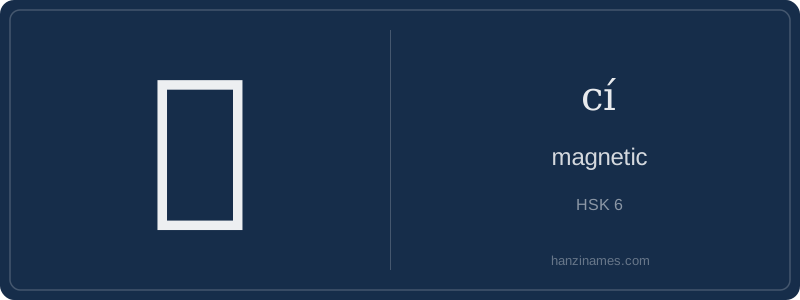
In contemporary China, 磁 is ubiquitous in STEM education, transportation, and consumer electronics. It appears in HSK 6 vocabulary as part of compound words like 磁铁 (cítiě, 'magnet') and 磁悬浮 (cíxuánfú, 'magnetic levitation'), essential for describing Shanghai’s maglev—the world’s first commercial high-speed maglev line (operational since 2004). The term 磁共振成像 (cí gòngzhèn chéngxiàng, 'magnetic resonance imaging') is standard in hospitals nationwide, reflecting its clinical precision and regulatory adoption by China’s NMPA since 2001.
The character’s form combines the stone radical 石 (indicating its mineral origin) with 慈 (cí, 'kindness') as phonetic component—no pictographic origin exists, as it’s a phono-semantic compound standardized during the Qin small seal script era. Its shape has remained stable for over 2,200 years, with no oracle bone or bronze inscriptions found—confirming its later emergence tied to scientific observation rather than early ritual use.
The character 磁 (cí) evokes the invisible yet powerful force of magnetism—felt daily in China’s high-tech world. From Shanghai’s maglev trains gliding silently at 430 km/h to MRI machines in Beijing hospitals, 磁 represents a fundamental physical phenomenon deeply embedded in modern infrastructure. Its radical 石 (shí, 'stone') reflects its ancient origin: naturally magnetic lodestone (magnetite), a black iron-rich mineral mined in Hebei and Anhui since the Han Dynasty.
Historically, 磁 was central to China’s pioneering navigation technology. The Song Dynasty (960–1279) text *Dream Pool Essays* by Shen Kuo documented the magnetic compass using ‘magnetic needle’ (磁针, cízhēn)—the first known written account of true magnetic declination. This wasn’t mystical symbolism but empirical science: lodestone’s directional property made maritime trade and coastal defense possible across the South China Sea.
Today, 磁 appears in both technical and metaphorical contexts. In classrooms, students learn 磁场 (cíchǎng, 'magnetic field') alongside Ohm’s law; on Weibo, netizens use 磁性 (cíxìng, 'magnetism') to describe a celebrity’s charismatic allure. Unlike abstract philosophical terms, 磁 retains tangible grounding—it’s measured in teslas, tested in labs, and soldered into every smartphone’s vibration motor.
Example Sentences
Common Compounds
Similar Characters — Don't Mix These Up
Your First Step into Chinese Culture: Get a Chinese Name
Every journey into Chinese begins with a name. Use our free Chinese name generator to create a meaningful, personalized Chinese name that fits you perfectly.
Get My Chinese Name →