磨
Character Story & Explanation
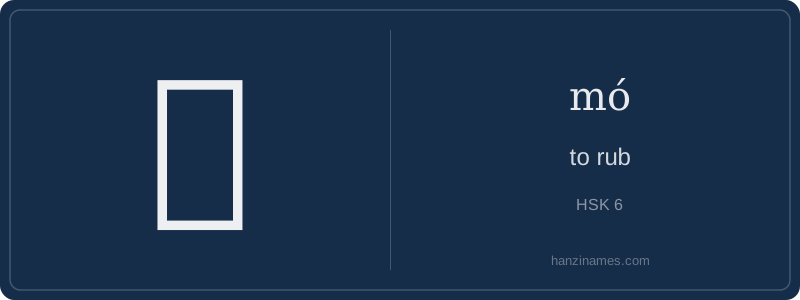
磨 has been used for millennia in practical and cultural contexts: ancient Chinese mills (石磨, shímò) ground wheat and soybeans, and the character appears in early dictionaries like the Shuōwén Jiězì (121 CE), classified under the 石 (stone) radical. Today, it’s essential in idioms like 千锤百炼,百炼成钢 (qiān chuí bǎi liàn, bǎi liàn chéng gāng — 'a thousand hammerings, a hundred temperings — steel is forged'), highlighting perseverance. Common phrases include 磨刀不误砍柴工 (módāo bù wù kǎncháigōng — 'sharpening the axe won’t delay firewood cutting'), emphasizing preparation.
The modern written form evolved from seal script, where 磨 clearly depicted two stones rubbing together — a documented pictographic origin. Archaeological evidence confirms stone mills were widespread by the Han Dynasty, making this character’s visual logic both historically grounded and functionally precise.
Hi everyone! Let’s explore 磨 (mó), a versatile character meaning 'to rub' — but it’s much more than that. At its core, 磨 describes physical abrasion: grinding grain, polishing jade, or sharpening a knife. But in Chinese, this literal action extends metaphorically to time, effort, and experience — like磨时间 (mó shíjiān, 'to kill time') or磨练 (móliàn, 'to temper through practice'). It’s a beautiful example of how Chinese connects concrete actions with abstract growth.
The character is built from the stone radical (石) on the left — telling us it’s related to hard materials — and a phonetic component (麻, má) on the right, which hints at pronunciation. Though pronounced mó here, it can also be mò (as in 石磨, shímò, 'stone mill'), showing how tone and context change meaning. Don’t worry — we’ll focus on the HSK 6 common reading mó first!
This character appears often in advanced vocabulary and idioms. For instance, 磨蹭 (móceng) means 'to dawdle', while 磨合 (móhé) refers to 'breaking in' — like new teammates learning to cooperate. These uses all share the idea of friction leading to refinement. Think of磨 as 'the process where resistance creates readiness' — whether you’re sharpening a blade or building resilience.
Example Sentences
Common Compounds
Similar Characters — Don't Mix These Up
Your First Step into Chinese Culture: Get a Chinese Name
Every journey into Chinese begins with a name. Use our free Chinese name generator to create a meaningful, personalized Chinese name that fits you perfectly.
Get My Chinese Name →