稀
Character Story & Explanation
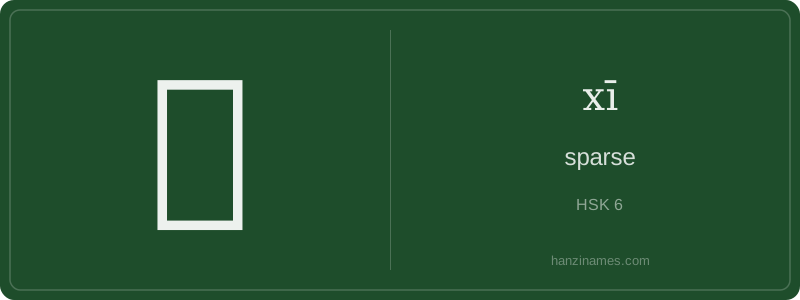
In daily Chinese, 稀 most commonly appears in compound words describing physical consistency or distribution: 稀饭 (xīfàn, 'congee') denotes rice boiled until grains separate and disperse in water; 稀疏 (xīshū, 'sparse/scattered') is used in ecology ('sparse forest cover'), urban planning ('sparse population density'), and data science ('sparse matrix'). It’s also key in the idiom 稀里哗啦 (xīlihuālā), an onomatopoeic phrase for chaotic, scattered sounds—like breaking dishes or heavy rain.
The character’s written form originates from small seal script (c. 200 BCE), combining 禾 (grain, indicating agricultural context) and 希 (xī, meaning 'rare' or 'few', serving phonetically and semantically). No oracle bone form exists—its earliest attestation is in Warring States bamboo texts, consistently tied to yield scarcity and material dilution, not mythical or ritual origins.
As an archaeologist brushing dust from a Han dynasty bamboo slip, I find 稀 inscribed in clerical script—not as a philosophical abstraction, but as a precise descriptor of grain distribution in tax records: fields yielding 'sparse harvests' (稀收) triggered state relief measures. Its禾 (grain) radical anchors it in agrarian reality, while the希 component (originally 'rarely seen') signals scarcity—not emptiness, but uneven density, like millet grains spaced too far apart in a storage bin.
This character resisted simplification; its form has remained stable since the Qin seal script, suggesting its semantic weight was never negotiable. In medical manuscripts from Mawangdui (2nd c. BCE), 稀 appears in prescriptions specifying 'diluted decoctions'—not weak, but *viscosity-controlled*, where particle dispersion mattered more than concentration. The 'scattered' sense thus emerges not from absence, but from intentional, measurable separation.
Modern linguistic excavation reveals 稀 functions as a scalar adjective: it quantifies distribution, not value. Unlike 'rare' (稀有), which implies preciousness, 稀 alone describes physical arrangement—like fog particles, crowd spacing, or data points on a graph. Its HSK 6 placement reflects this nuanced, context-dependent precision: learners must discern when 稀 means 'thin' (soup), 'sparse' (population), or 'dilute' (solution)—all unified by the core idea of reduced density without loss of essence.
Example Sentences
Common Compounds
Similar Characters — Don't Mix These Up
Your First Step into Chinese Culture: Get a Chinese Name
Every journey into Chinese begins with a name. Use our free Chinese name generator to create a meaningful, personalized Chinese name that fits you perfectly.
Get My Chinese Name →