稼
Character Story & Explanation
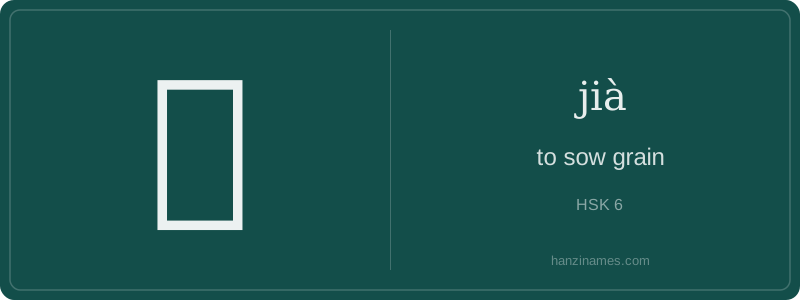
In contemporary China, 稼 appears most frequently in formal writing and set phrases—not casual speech. It’s essential in the classical compound 稼穑 (jiàsè), meaning 'to sow and reap', cited in official documents on agricultural heritage and featured in UNESCO-recognized intangible cultural practices like the '24 Solar Terms'. The Ministry of Agriculture’s annual 'National Grain Production Plan' occasionally uses 稼 in slogans emphasizing 'scientific sowing' (科学种稼). It also appears in names of rural cooperatives and agri-tech initiatives to evoke tradition and trust.
The character is a phono-semantic compound: 禾 (radical, 'grain') + 家 (jiā, phonetic component, suggesting pronunciation jià). While 家 normally means 'home', here it serves primarily as a sound cue—though its presence subtly reinforces the idea that grain cultivation is foundational to family and society. No oracle-bone or bronze script forms survive for 稼; it first appears reliably in Warring States bamboo texts and Han dynasty dictionaries like the *Shuōwén Jiězì*.
The character 稼 (jià) evokes the quiet rhythm of rural China—dawn mist over golden rice paddies, farmers bending low with seed baskets, hands brushing soil as they scatter grain. Its radical 禾 (hé), meaning 'grain' or 'cereal plant', anchors it firmly in agriculture—the lifeblood of ancient and modern China alike. Though rarely used alone today, 稼 carries the weight of generational labor: sowing not just seeds, but hope, timing, and stewardship of land.
Historically, 稼 appears in classical texts like the *Book of Songs* (Shījīng), where it pairs with 穑 (sè, 'to reap') to form the foundational agricultural cycle: 稼穑 (jiàsè)—'sowing and harvesting'. This pairing reflects Confucian ideals of diligence and harmony with nature. Even today, government reports on food security or rural revitalization sometimes invoke 稼 to lend gravitas and cultural resonance to policy language.
While modern Mandarin speakers more commonly use verbs like 播种 (bōzhǒng, 'to sow') in daily speech, 稼 survives in formal, literary, and compound contexts—imbuing phrases with poetic density and historical continuity. Its fifteen strokes trace a deliberate, grounded motion: the left side (禾) stands tall like a stalk; the right side (家) suggests domestic responsibility—sowing is never just farming, but caring for family and future. It’s a character that roots language in the earth.
Example Sentences
Common Compounds
Similar Characters — Don't Mix These Up
Your First Step into Chinese Culture: Get a Chinese Name
Every journey into Chinese begins with a name. Use our free Chinese name generator to create a meaningful, personalized Chinese name that fits you perfectly.
Get My Chinese Name →