穴
Character Story & Explanation
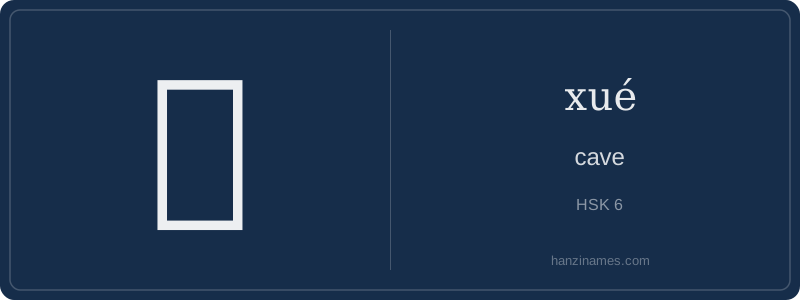
In modern Chinese, 穴 most commonly appears in medical, geographical, and architectural contexts. It’s essential in terms like 针灸穴位 (zhēnjiǔ xuèwèi, 'acupuncture points')—a concept documented since the Han Dynasty’s Huangdi Neijing (c. 2nd century BCE). The phrase 地穴 (dìxué, 'underground chamber') appears in Ming-Qing dynasty records describing imperial tomb structures. Today, it’s widely used in news reports about cave dwellings (窑洞 yáodòng) in Shaanxi, where natural or excavated 穴 serve as homes.
The character’s form is a documented pictograph: oracle bone and bronze inscriptions show a stylized outline of a cave entrance with a roof-like cover above and an open space below—a clear visual representation of a sheltered hollow. This early pictographic origin remains legible in the modern shape.
Hi students! Let’s explore 穴 (xué), a foundational character meaning 'cave' or 'hole'. Though simple—just five strokes—it carries rich semantic weight. It’s both a standalone word and a key radical appearing in many characters related to hollow spaces, openings, or shelter: like 突 (tū, 'sudden', originally 'breaking through a wall'), 空 (kōng, 'empty'), and 窗 (chuāng, 'window'). Notice how the top part resembles a roof or cover, and the bottom suggests an opening beneath—this visual logic helps memory!
This character is more than geological: in traditional Chinese medicine, 'xué' refers to acupuncture points—tiny, precise 'holes' on the body where energy flows. So while its basic meaning is physical ('cave'), it extends metaphorically to vital, functional locations. That duality—concrete space + functional locus—is central to understanding many compound words. Don’t just memorize 'cave'; think 'meaningful opening'.
As a radical (also called the 'cave radical' or 穴字头 xuézì tóu), it always appears at the top of characters, signaling spatial containment or penetration. Unlike radicals that hint at sound (phonetic components), this one is purely semantic—it tells you *what kind of thing* the character is about. Practice writing it slowly: dot, left-falling stroke, horizontal stroke, then two connected dots (or sometimes a 'small' and 'big' dot). Its simplicity belies its importance—it’s your gateway to dozens of higher-level HSK 6 words!
Example Sentences
Common Compounds
Similar Characters — Don't Mix These Up
Your First Step into Chinese Culture: Get a Chinese Name
Every journey into Chinese begins with a name. Use our free Chinese name generator to create a meaningful, personalized Chinese name that fits you perfectly.
Get My Chinese Name →