窜
Character Story & Explanation
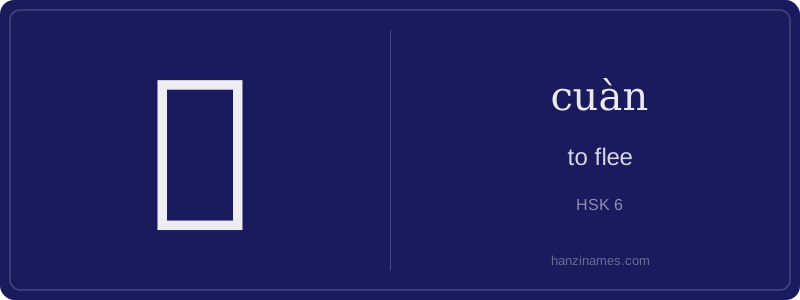
Historically, 窜 appears in classical texts like the Book of Documents (Shūjīng) describing the banishment of corrupt ministers: '流共工于幽州,放驩兜于崇山,竄三苗于三危' ('Banished Gonggong to Youzhou, exiled Huandou to Chongshan, and cuàn the Sanmiao tribe to Sanwei'). In modern Chinese, it’s most common in formal or literary contexts—especially in compounds like 流窜 (liúcuàn, 'to rove/commit crimes while fleeing') and 窜逃 (cuàntáo, 'to flee and hide'). It rarely appears in casual speech but surfaces frequently in news reports about fugitives, corruption cases, or wartime desertion.
The character is not pictographic; its earliest attested form is in Warring States bamboo manuscripts. Its structure is semantic-phonetic: 穴 (cave, implying concealment) + 串 (chuàn, phonetic, though its meaning 'stringing together' may metaphorically suggest fragmented, opportunistic movement). Today, Chinese speakers use it precisely in contexts demanding moral condemnation—e.g., '他畏罪窜往境外' ('He fled abroad to evade punishment').
As an archaeologist brushing dust from a Han dynasty bamboo slip, I find 窜 etched not as a gentle retreat—but as a desperate, sideways scramble. Its radical 穴 (cave/hole) anchors the character in subterranean concealment, while the phonetic component 串 (chuàn, 'to string together') subtly evokes rapid, linked motion—like a fugitive darting between hiding places. This isn’t strolling away; it’s vanishing into the margins of society.
The character’s twelve strokes map a visceral trajectory: starting high with the cave’s roof (宀), then descending sharply through zigzag ‘legs’ (中 + 一 + 川-like curves), ending in a hurried, off-balance final stroke. Early clerical script variants show exaggerated angularity—suggesting urgency encoded in ink. Even today, its shape feels kinetic, almost unstable—a visual onomatopoeia for evasion.
Unlike neutral synonyms like 逃 (táo, 'to escape'), 窜 carries moral gravity: it implies guilt, shame, or illegitimacy. In imperial legal texts, '窜' marked banishment to remote frontiers—not mere exile, but erasure from civil order. The character doesn’t just describe movement; it judges intent. To ‘cuàn’ is to be cast out, not to step aside. That stigma echoes in modern usage, where it still colors political or journalistic discourse about defection or cover-ups.
Example Sentences
Common Compounds
Similar Characters — Don't Mix These Up
Your First Step into Chinese Culture: Get a Chinese Name
Every journey into Chinese begins with a name. Use our free Chinese name generator to create a meaningful, personalized Chinese name that fits you perfectly.
Get My Chinese Name →