筐
Character Story & Explanation
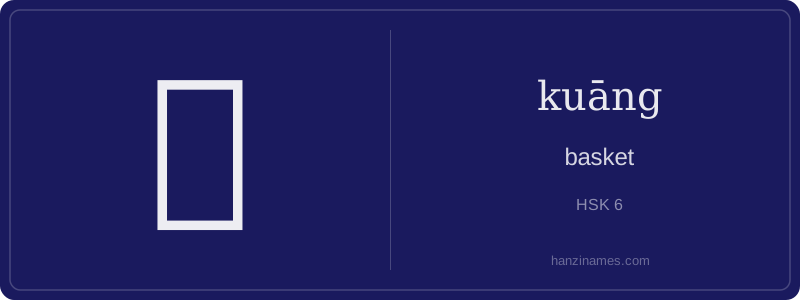
In daily life, 筐 remains widely used across rural and urban China—especially in markets, farms, and household storage. It appears in fixed phrases like ‘竹筐’ (zhú kuāng, bamboo basket) and ‘菜筐’ (cài kuāng, vegetable basket), and in the idiom ‘一筐话’ (yī kuāng huà), meaning ‘a basketful of talk’—colloquially, rambling or excessive chatter. Historically, tax records from the Tang and Song dynasties list ‘麦筐’ (wheat baskets) as standard units for grain levies, confirming its role in administration.
The character is a clear phono-semantic compound: ⺮ (bamboo) indicates material; 匡 provides pronunciation and hints at ‘containing/correcting’. No oracle bone or bronze inscription evidence exists for 筐—it first appears in mature seal script, reflecting its origin as a functional term for standardized woven containers in early imperial bureaucracy.
Our detective work begins with the radical ⺮—the bamboo radical—immediately signaling that 筐 is made of or associated with bamboo, a material historically central to basket-making across East Asia. The right side, 匡 (kuāng), serves both phonetic and semantic roles: it sounds like the character and originally meant 'to correct' or 'to hold in place', subtly echoing how a basket holds and organizes contents. This dual function—material + function—is typical of phono-semantic compound characters.
Tracing its evolution, 筐 appears reliably in seal script (c. 3rd century BCE) and clerical script, already bearing its modern structure. Unlike some characters with debated oracle bone origins, 筐 has no attested pre-Qin inscriptions—it emerged as a standardized term during the Warring States and Han periods when woven containers became essential for agriculture, taxation, and ritual. Its 12-stroke form stabilized early, with consistent stroke order documented in Kangxi Dictionary (1716).
The character’s design reflects practical engineering: the bamboo top (⺮) suggests flexibility and lightness, while 匡 implies containment and measured capacity. In classical texts like the *Book of Rites*, 筐 appears in descriptions of ceremonial grain offerings—always specifying size and material. This functional precision underscores why it earned HSK Level 6 status: it’s not just ‘basket’, but a culturally embedded tool implying purpose, craftsmanship, and context-sensitive usage.
Example Sentences
Common Compounds
Similar Characters — Don't Mix These Up
Your First Step into Chinese Culture: Get a Chinese Name
Every journey into Chinese begins with a name. Use our free Chinese name generator to create a meaningful, personalized Chinese name that fits you perfectly.
Get My Chinese Name →