筹
Character Story & Explanation
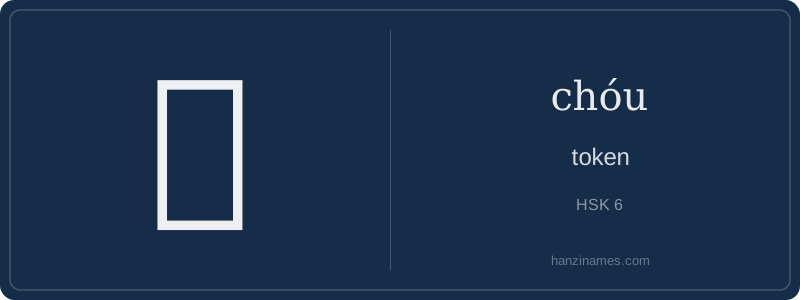
In daily life, 筹 most commonly appears in formal or administrative contexts: 筹款 (chóu kuǎn, 'fundraising'), 筹划 (chóu huà, 'to plan/organize'), and 筹备 (chóu bèi, 'to prepare'). It’s frequent in news headlines about Olympic preparations (如:筹备北京冬奥会) and NGO reports. A well-documented idiom is 运筹帷幄 (yùn chóu wéi wò), meaning 'to plan strategically from behind the scenes' — originating from Sima Qian’s *Records of the Grand Historian* (c. 94 BCE), describing Liu Bang’s strategist Zhang Liang.
The character’s written form is not pictographic but phono-semantic: ⺮ (bamboo) signals material origin; the right component 寿 (shòu) provides sound. No oracle bone form exists — earliest attestation is on Warring States bamboo manuscripts. Today, Chinese learners encounter it in HSK 6 reading passages about policy implementation or project management, where it consistently conveys structured, quantifiable preparation.
As a detective tracing 筹’s evolution, I begin with its bamboo radical (⺮) — an unmistakable clue. Ancient Chinese used split bamboo strips as counting tools, tally sticks, and voting tokens in military councils and state administration. The right side, 壽 (shòu, later simplified to 寿), originally signaled longevity but here served phonetically — its Old Chinese pronunciation *djuʔ closely matched early forms of chóu. This phonosemantic structure reveals how practical objects (bamboo chips) became abstract symbols of calculation and planning.
The character first appears reliably in Warring States bamboo slips (475–221 BCE), where ‘chóu’ meant physical counting rods used in mathematics and logistics. By the Han dynasty, it extended metaphorically: ‘planning’ (as in 筹划) emerged because strategists literally laid out bamboo tokens to map troop movements and resource allocation. The shift from concrete token → abstract strategy reflects how material culture shaped language — each stroke encodes centuries of bureaucratic and military practice.
Crucially, 筹 never meant ‘chip’ in the modern gaming sense (like poker chips); that usage is rare and largely loan-translated. Its core semantic field remains tied to *measurable, countable units* used for decision-making: lottery tickets (彩票), fundraising quotas (筹款指标), or academic research milestones (筹措经费). Even today, when officials ‘raise funds’ (筹资), they’re conceptually ‘assembling counted units’ — a direct linguistic echo of bamboo tally sticks laid side-by-side on a strategist’s desk.
Example Sentences
Common Compounds
Similar Characters — Don't Mix These Up
Your First Step into Chinese Culture: Get a Chinese Name
Every journey into Chinese begins with a name. Use our free Chinese name generator to create a meaningful, personalized Chinese name that fits you perfectly.
Get My Chinese Name →