粉
Character Story & Explanation
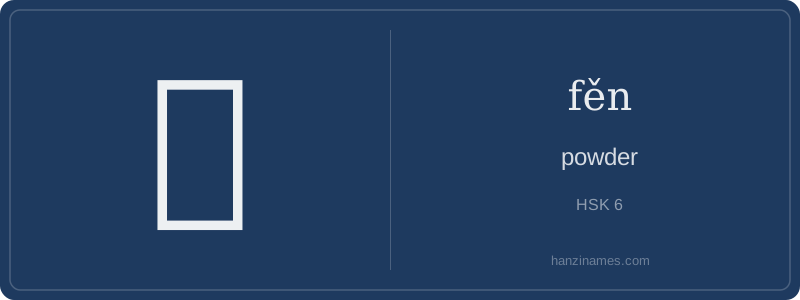
粉 has been used since at least the Han Dynasty (206 BCE–220 CE) for cosmetic powders—archaeological finds from Mawangdui tombs include lacquer boxes containing finely ground rice and lead-based face powders. Today, it appears ubiquitously: in food (糯米粉, glutinous rice flour), cosmetics (爽身粉, talcum powder), and internet slang (粉丝, 'fan'). A well-documented idiom is 粉墨登场 (fěnmò dēngchǎng), literally 'powder-and-ink ascend the stage', meaning 'to make a debut in public life'—originating from traditional opera performers applying facial makeup before performing.
The character is not pictographic but phono-semantic: 米 (radical, indicating grain-related meaning) + 分 (phonetic, suggesting pronunciation and the idea of division/grinding). Its earliest attested form appears in clerical script (Lìshū) during the Han, already with this structure—no oracle bone or bronze inscriptions survive for 粉, confirming its later lexical emergence tied to milling technology.
The character 粉 (fěn) embodies the Chinese worldview’s reverence for transformation—how raw, granular matter becomes refined, functional, and even symbolic. Historically, rice powder (米粉) was ground by hand for nourishment and ritual purity; later, face powder (香粉) reflected Confucian ideals of modesty and cultivated appearance. Powder isn’t inert—it’s a transitional state: between substance and air, visibility and subtlety, labor and elegance.
Its radical 米 (rice) roots it in sustenance and agrarian life, while the phonetic component 分 (fēn, 'to divide') hints at the act of breaking down—physically and philosophically. In Daoist thought, this mirrors the generative power of fragmentation: from one grain, countless particles; from chaos, ordered utility. Powder thus represents both humility (ground-down simplicity) and potential (a medium ready to mix, adhere, or transform).
In modern China, 粉 extends metaphorically into digital culture—'fans' (粉丝, fěnsī) are 'powder-threads', suggesting dispersed individuals coalescing around shared admiration like fine particles drawn by static charge. This reflects a collectivist sensibility where identity forms not in isolation but through relational adhesion—echoing how rice powder only gains function when mixed with water or oil. The character quietly encodes a worldview where meaning emerges through interaction, not essence alone.
Example Sentences
Common Compounds
Similar Characters — Don't Mix These Up
Your First Step into Chinese Culture: Get a Chinese Name
Every journey into Chinese begins with a name. Use our free Chinese name generator to create a meaningful, personalized Chinese name that fits you perfectly.
Get My Chinese Name →