粹
Character Story & Explanation
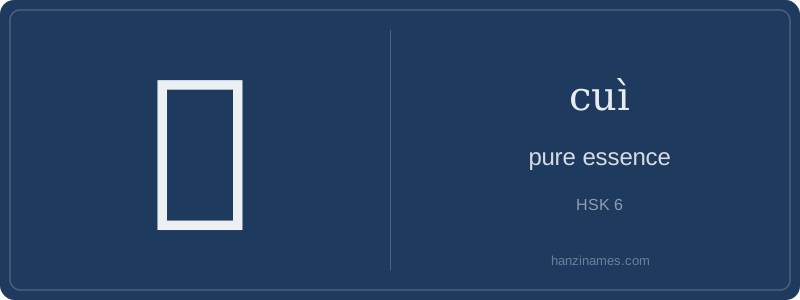
In modern Chinese, 粹 appears most frequently in formal, literary, or ideological contexts—not daily conversation. It’s central to the term 国粹 (guócuì, 'national quintessence'), officially promoted since the early 20th century to refer to traditional arts like Peking opera, calligraphy, and classical poetry as culturally 'pure' and uniquely Chinese. The phrase 精粹 (jīngcuì, 'essence') is common in academic writing and media headlines to denote distilled knowledge or core ideas.
The character has no verified pictographic origin—it emerged as a late Zhou dynasty phonosemantic compound. Today, Chinese learners encounter it primarily in HSK 6 vocabulary lists and official cultural policy documents. A typical real-life use? A museum placard describing a Song-dynasty ink painting as ‘笔墨精粹’ (bǐmò jīngcuì)—'the quintessence of brush and ink.'
Our detective begins at the crime scene: the character 粹 (cuì), first attested in bronze inscriptions of the Warring States period and standardized in the Shuōwén Jiězì (121 CE) as a phonosemantic compound. The 米 (mǐ, 'rice') radical signals association with grain—historically, the purest rice was unadulterated, winnowed free of husks and chaff. This agricultural precision seeded the abstract meaning of 'unmixed essence'.
The right component, 卒 (zú), originally depicted a soldier’s cap and later came to mean 'completed' or 'finally'—here serving phonetically (both 卒 and 粹 share the *-ui* rime in Middle Chinese). But crucially, it also subtly reinforces semantic weight: what is 'completed' in refinement becomes 'quintessential'. No oracle-bone form exists for 粋; its earliest secure appearance is in Warring States bamboo texts like the Guodian Chu Slips, where it describes moral purity.
By the Han dynasty, 粹 evolved beyond agriculture into philosophy—especially Daoist and Neo-Confucian texts—to denote undiluted principle or authentic nature. Unlike 洁 (jié, 'clean') or 纯 (chún, 'pure' in a general sense), 粹 implies elite, distilled excellence: not just absence of impurity, but presence of concentrated virtue or mastery. Its rarity in everyday speech reflects its elevated register—reserved for art criticism, classical scholarship, and ideological discourse.
Example Sentences
Common Compounds
Similar Characters — Don't Mix These Up
Your First Step into Chinese Culture: Get a Chinese Name
Every journey into Chinese begins with a name. Use our free Chinese name generator to create a meaningful, personalized Chinese name that fits you perfectly.
Get My Chinese Name →