紊
Character Story & Explanation
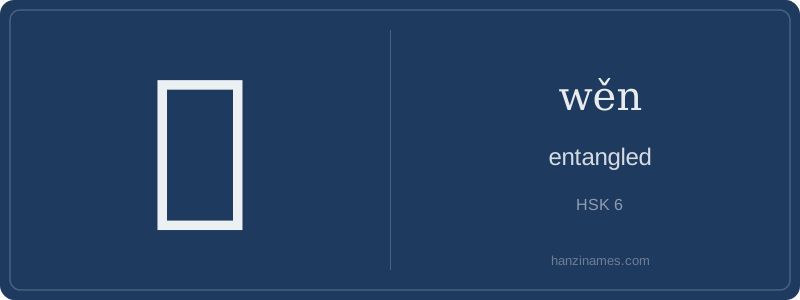
紊 is rare in spoken Mandarin but appears in formal writing, journalism, and policy documents to describe systemic disarray—e.g., '管理紊乱' (management disorder) in government audit reports. It features in the classical idiom '纲举目张,紊则失序' (when the main principle is clear, details follow; if tangled, order collapses), cited in Song dynasty Confucian commentaries. Modern media uses it critically: Xinhua News Agency once described financial regulation as '监管体系仍显紊乱' (the oversight system remains visibly entangled).
The character has no verified pictographic origin—it first appears in clerical script (Lìshū) during the Han dynasty. Its structure is purely phono-semantic: 糸 (silk radical, hinting at entanglement) + 文 (wén, providing sound and connoting 'pattern'). Today, Chinese speakers most often encounter it in written critiques of institutions—not in speech, but in editorials, academic papers, or civil service exams.
As a detective tracing 紊’s evolution, I begin at the crime scene: the character’s structure. Its left side is the silk radical 糸—suggesting entanglement, like threads knotted beyond easy untangling. The right side, 文 (wén), originally meant 'pattern' or 'culture', but here acts phonetically while subtly implying complexity of form—like ornate embroidery gone awry. Together, they don’t depict chaos outright, but *ordered complexity turned disorderly*.
Historically, 紊 appears late in classical texts—first reliably in Han dynasty commentaries and Tang poetry—not as a pictograph, but as a phono-semantic compound. It was never an oracle-bone or bronze script character. Its emergence correlates with refined bureaucratic language, where precise terms for ‘disorder within system’ were needed—e.g., describing administrative confusion without blaming incompetence outright.
This character doesn’t mean simple 'mess'; it implies *entanglement*: interwoven causes, layered complications, systemic involvement. Think of a legal case where jurisdiction, precedent, and personal interest tangle—a situation not random, but *too involved*. That nuance is why it’s HSK 6: learners must grasp not just definition, but register—formal, literary, slightly critical—and its preference for abstract, high-stakes contexts over daily clutter.
Example Sentences
Common Compounds
Similar Characters — Don't Mix These Up
Your First Step into Chinese Culture: Get a Chinese Name
Every journey into Chinese begins with a name. Use our free Chinese name generator to create a meaningful, personalized Chinese name that fits you perfectly.
Get My Chinese Name →