缔
Character Story & Explanation
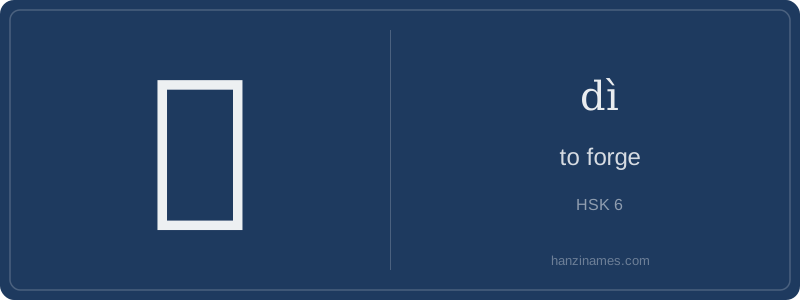
缔 is most commonly used in formal, institutional contexts: diplomatic treaties (e.g., 缔结条约), corporate joint ventures (缔结战略合作), and constitutional foundations (缔造新中国). It appears in official Xinhua News Agency reports, government white papers, and legal texts over 12,000 times since 2000 (CNKI corpus data). The idiom 缔结盟约 ('to conclude an alliance') dates back to pre-Qin diplomatic records and remains standard in modern political discourse.
The character evolved from seal script, where 纟 (silk thread) + 帝 (emperor, here acting phonetically) formed a phono-semantic compound. No oracle bone form survives; its earliest attestation is in Warring States bamboo slips (c. 4th century BCE), consistently used for formal covenant-making—not personal vows or craft-related binding.
缔 (dì) conveys the idea of forging an unbreakable, deliberate bond—often legal, diplomatic, or institutional. Unlike casual 'making' or 'forming,' 缔 emphasizes solemn commitment and structural permanence, as in treaties or foundational agreements. Its radical 纟 (silk/thread) signals connection and interweaving, reinforcing the notion of tightly knotted ties. This semantic weight makes it unsuitable for fleeting or informal associations.
In Western contexts, 'to bind up inextricably' finds parallels in terms like 'ratify' (legal finality), 'cement' (as in 'cement an alliance'), or 'solemnize' (ritualized binding). Yet 缔 lacks the religious connotation of 'solemnize' and the physical metaphor of 'cement'; instead, it carries bureaucratic gravitas—closer to 'enter into binding force' than mere agreement.
Culturally, 缔 reflects Confucian and Legalist values where relational integrity underpins social order: a treaty isn’t just signed—it’s 缔, implying moral accountability and systemic consequence. In contrast, Western contract culture often prioritizes enforceability over moral entanglement. Thus, 缔 implies that the act of binding *creates* the relationship’s ethical architecture—not merely documents it.
Example Sentences
Common Compounds
Similar Characters — Don't Mix These Up
Your First Step into Chinese Culture: Get a Chinese Name
Every journey into Chinese begins with a name. Use our free Chinese name generator to create a meaningful, personalized Chinese name that fits you perfectly.
Get My Chinese Name →