纤
Character Story & Explanation
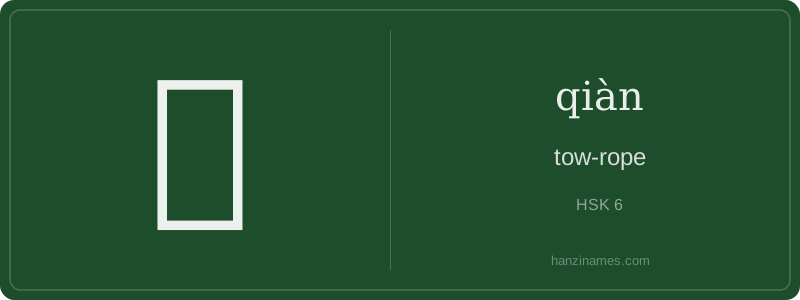
In historical usage, 纤 (qiàn) appears in imperial transport records, regional poetry (e.g., Du Fu’s river poems referencing ‘牵纤’), and late-Qing travelogues describing the perilous Three Gorges towpaths. Modern usage is almost exclusively literary or historical — appearing in textbooks, museum exhibits on traditional transportation, and idioms like ‘纤毫毕现’ (xiān háo bì xiàn, 'every hair-like detail rendered clearly'), where it uses the xiān reading. The term ‘纤夫’ remains culturally resonant, symbolizing endurance — notably in the famous Sichuan folk song ‘The Boatman’s Chanty’ (《川江号子》).
The character is not pictographic but phono-semantic: ‘纟’ (silk/thread radical) indicates meaning related to fiber or string; ‘千’ (qiān, ‘thousand’) serves as a phonetic component for qiàn (a common sound shift in Middle Chinese). No oracle bone or bronze script form survives — its earliest attestation is in seal script from the Qin dynasty (3rd c. BCE), already bearing this structure.
Unearthing this character feels like brushing dust from a Tang dynasty riverbank: 纤 (qiàn) emerges not as a delicate thread, but as raw, sun-baked rope — thick hemp cord stretched taut between boatman and barge. Its six strokes encode labor: the left-hand ‘纟’ radical signals fiber or binding; the right-hand ‘千’ (thousand) evokes collective human effort — hundreds of hands hauling vessels upstream against the Yangtze’s current. This is not abstraction; it is muscle, mud, and momentum.
Archaeological records confirm that during the Ming and Qing dynasties, official transport relied on ‘纤夫’ (qiànfū) — rope-haulers who walked narrow towpaths, backs bent, ropes digging into shoulders. Tax documents, local gazetteers, and stele inscriptions from Sichuan and Hubei list ‘纤银’ (qiàn yín), special levies to maintain towpaths and pay haulers. The character’s qiàn reading thus anchors it in infrastructure, logistics, and state-controlled riverine commerce — a lexical artifact of pre-industrial China’s hydraulic economy.
Yet the same glyph also whispers another truth: xiān, meaning ‘fine’, ‘delicate’, ‘slender’. This duality isn’t contradiction — it’s semantic stratification. Just as rope is spun from fine fibers, the ‘coarse’ tow-rope (qiàn) and the ‘refined’ fineness (xiān) share the same root: controlled tension, purposeful thinness. The character preserves both ends of the fiber spectrum — strength derived from slenderness, labor made possible by precision. It is etymology as physics: tensile integrity encoded in ink.
Example Sentences
Common Compounds
Similar Characters — Don't Mix These Up
Your First Step into Chinese Culture: Get a Chinese Name
Every journey into Chinese begins with a name. Use our free Chinese name generator to create a meaningful, personalized Chinese name that fits you perfectly.
Get My Chinese Name →