缠
Character Story & Explanation
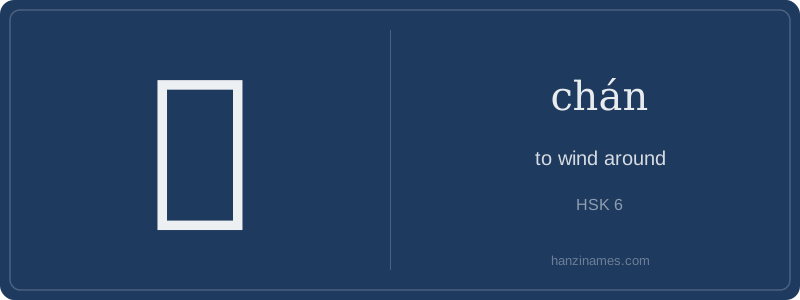
In daily life, 缠 appears frequently in expressions like ‘他老缠着我问问题’ (He keeps pestering me with questions) — a common complaint among teachers and parents. It’s central in idioms like 恋恋不舍 (liànliàn bù shě), where 缠 contributes to the sense of clinging affection. Historically, the character appears in Tang dynasty poetry describing willow branches ‘缠枝’ (winding around branches) and in medical texts like the Huangdi Neijing referring to pathogenic qi ‘缠绕脏腑’ (coiling around organs).
The written form evolved from seal script, where the left side (纟) clearly represented silk threads, and the right side (廛) was a phonetic component (chán), originally denoting a marketplace — later standardized as 廛 in some variants. No oracle-bone form survives; its earliest attested use is in Warring States bamboo slips meaning ‘to bind tightly with cord’.
Hi students! Let’s explore 缠 (chán), a verb meaning 'to wind around', 'to coil', or 'to entangle'. It’s not just about physical twisting — it often carries a sense of persistence, repetition, or even gentle insistence. Think of yarn wrapping around a finger, vines climbing a trellis, or someone repeatedly asking a question until you answer. The character feels tactile and rhythmic — like motion that loops back on itself.
This character belongs to the silk (纟) radical, which appears in many words related to threads, textiles, and by extension, connections or complications. Its 13 strokes include curved, looping movements — mirroring its meaning. As an HSK Level 6 word, 缠 shows up in advanced vocabulary like emotional entanglement (纠缠) or persistent requests (缠着要…). Don’t worry — we’ll break it down step by step!
Notice how 缠 is rarely used alone in modern speech. It usually pairs with other characters to form compound verbs or nouns: 缠绕 (chánrào, to coil around), 纠缠 (jiūchán, to pester or get entangled), or 缠绵 (chánmián, tenderly lingering — often describing love or illness). These compounds help you grasp its emotional weight: not just physical winding, but emotional or situational 'sticking'.
Example Sentences
Common Compounds
Similar Characters — Don't Mix These Up
Your First Step into Chinese Culture: Get a Chinese Name
Every journey into Chinese begins with a name. Use our free Chinese name generator to create a meaningful, personalized Chinese name that fits you perfectly.
Get My Chinese Name →