署
Character Story & Explanation
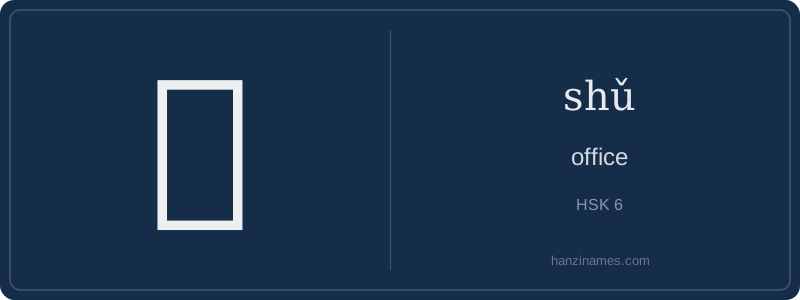
署 is used today almost exclusively in formal, institutional compound nouns — especially in governmental, diplomatic, and regulatory bodies. Common phrases include 办公署 (bànɡōnɡ shǔ, 'administrative office') and 驻外使领馆的领事署 (lǐnɡshì shǔ, 'consular section of an embassy'). It appears in historical records dating to the Tang Dynasty (618–907 CE) in documents referencing provincial administrative bureaus (如州署, zhōu shǔ). The HSK 6 list includes it precisely because of its high-frequency appearance in official media and policy texts.
The character’s form is not pictographic but phono-semantic: the top 罒 is a variant of 网 (wǎng, 'net'), historically used as a radical for surveillance or regulation; the bottom 者 (zhě) serves as the phonetic component. No oracle-bone or bronze inscription evidence exists for 署 — it first appears in clerical script during the Han Dynasty, reflecting its bureaucratic origin rather than natural imagery.
The character 署 (shǔ) embodies the Confucian ideal of structured, responsible governance — not merely a physical space, but a locus of authority, accountability, and public service. Its radical 罒 (‘net’ or ‘eye’) suggests oversight and vigilance, while the phonetic component 者 (zhě) implies a person engaged in deliberate action. In classical Chinese thought, an office was never neutral; it was where moral duty met administrative function.
Historically, 署 denoted government bureaus in imperial administrations — such as the Ministry of Rites (礼部署) — where ritual propriety and bureaucratic precision converged. This reflects a worldview where legitimacy arises not from power alone, but from proper placement within hierarchical, ethically grounded institutions. The character thus encodes the idea that authority must be visibly organized, publicly accountable, and morally anchored.
In modern usage, 署 retains this gravitas: it appears in formal institutional names like 外交部 (Ministry of Foreign Affairs), but never in casual contexts like 'my coworking space'. Its presence signals officialdom, continuity with tradition, and state-sanctioned function. Unlike Western 'office' — often associated with individual work — 署 evokes collective mandate, procedural integrity, and the weight of public trust.
Example Sentences
Common Compounds
Similar Characters — Don't Mix These Up
Your First Step into Chinese Culture: Get a Chinese Name
Every journey into Chinese begins with a name. Use our free Chinese name generator to create a meaningful, personalized Chinese name that fits you perfectly.
Get My Chinese Name →