耍
Character Story & Explanation
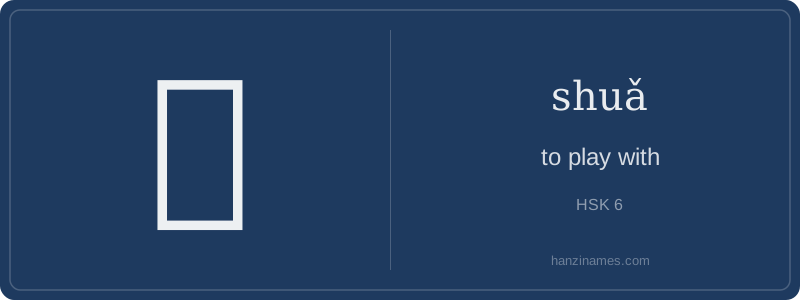
耍 appears frequently in modern Mandarin in both literal and figurative contexts: children 耍玩具 (shuǎ wánjù, 'play with toys'), performers 耍杂技 (shuǎ zájì, 'perform acrobatics'), and politicians accused of 耍手段 (shuǎ shǒuduàn, 'using underhanded tactics'). A well-documented idiom is 耍滑头 (shuǎ huá tou), meaning 'to be crafty or evade responsibility,' widely attested in 20th-century literature and official media. Historically, 耍 entered vernacular texts by the Ming dynasty, commonly in storytelling and opera scripts describing physical performance.
The character’s form has no verified pictographic origin—it evolved from seal script variants combining 女 (nǚ, 'female') and 而 (ér, here serving phonetically). Today, Chinese people commonly use 耍 in casual speech like '别耍了!' (Bié shuǎ le! — 'Stop messing around!'), capturing its dual tone of lightheartedness and mild reproof—reflecting how 'play' is socially calibrated, never neutral.
The character 耍 (shuǎ) embodies a uniquely Chinese blend of playful agency and embodied skill—less about idle amusement, more about active, often performative engagement. In Confucian-influenced culture, 'play' is rarely frivolous; it carries undertones of mastery, improvisation, and social fluency—think of martial artists 'playing' with swords (耍刀) or children 'playing' at roles to rehearse social identity. This reflects a worldview where learning, artistry, and even politics unfold through iterative, embodied practice rather than abstract theory alone.
Etymologically linked to the radical 而 (ér)—originally depicting a beard, later repurposed as a phonetic component—耍’s structure signals that play is not childish but *adulthood performed with lightness*. Its nine strokes flow with rhythmic balance: three horizontal lines at the top suggest repetition or layers of meaning; the lower part (女 + 而) subtly evokes grace under control. This mirrors how Chinese aesthetics value spontaneity *within* discipline—like calligraphy strokes that look effortless but demand years of training.
Crucially, 耍 avoids Western binaries of 'work vs. play' or 'serious vs. trivial.' To 耍 a trick (耍花招), a qin (耍琴), or even time (耍赖) implies conscious, skilled manipulation—not deception per se, but strategic, context-aware navigation. In this light, 耍 reveals a cultural truth: competence is demonstrated not just in doing, but in *how* one does—with wit, rhythm, and relational awareness. It’s philosophy in motion, coded into nine brushstrokes.
Example Sentences
Common Compounds
Similar Characters — Don't Mix These Up
Your First Step into Chinese Culture: Get a Chinese Name
Every journey into Chinese begins with a name. Use our free Chinese name generator to create a meaningful, personalized Chinese name that fits you perfectly.
Get My Chinese Name →