肆
Character Story & Explanation
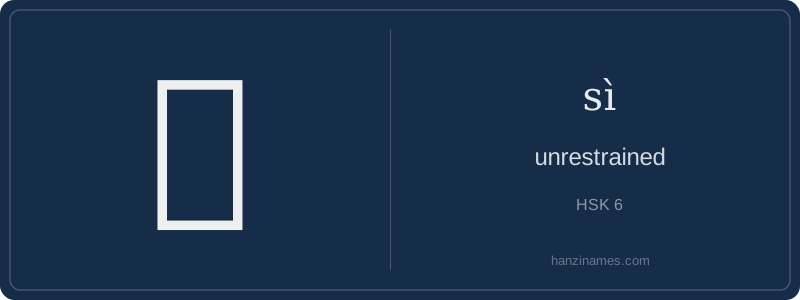
肆 is rarely used alone in modern Mandarin and never means 'four' in daily speech—its primary role is in formal compounds denoting excess, openness, or official authorization. It appears in legal terms like 肆业 (sìyè, ‘to withdraw from school’), financial contexts like 肆元 (sì yuán, archaic ‘four yuan’ on pre-1949 banknotes), and idioms such as 肆无忌惮 (sì wú jì dàn, ‘utterly reckless’). Historically, it was common on Qing dynasty merchant seals and imperial edicts to signify ‘full authority’ or ‘complete validity’.
The character’s form originates from seal script, where it combined 聿 (a hand holding a brush) and 四 (phonetic). No oracle bone or bronze inscriptions confirm an earlier pictographic stage—it entered standardized writing as a phonosemantic compound during the Qin unification. Today, Chinese people encounter it most often on academic certificates (肄业证) or in classical literature study—not as ‘four’, but as a marker of gravity and scale.
As an archaeologist brushing dust from a Han dynasty bamboo slip, I find 肆 not as a simple numeral—but as a scribe’s deliberate, almost ceremonial stroke. Its earliest attested form in seal script (c. 3rd century BCE) already bears the ‘聿’ (yù) radical—depicting a hand holding a brush—suggesting its original link to writing, record-keeping, and formal enumeration. The ‘四’ (sì, ‘four’) component was later added as a phonetic loan, but the character never functioned as the everyday word for ‘four’; that role belongs solely to 四.
What emerges is a semantic pivot: 肆 evolved from ‘to write/record the number four’ into ‘to extend fully’, then ‘to act without restraint’. By the Warring States period, texts like the *Zuo Zhuan* use it for ‘uninhibited conduct’—a semantic leap rooted not in pictorial logic, but in bureaucratic precision: recording numbers demanded completeness, and completeness implied boundlessness. Thus, ‘four’ became metaphor for totality—not quantity, but scope.
This explains why 肆 appears in legal and ritual contexts: the *Rites of Zhou* prescribes ‘肆赦’ (sì shè)—‘full amnesty’—where ‘肆’ signals comprehensive, unreserved pardon. Even today, its aura of extremity persists: not ‘four things’, but ‘fourfold intensity’. Its thirteen strokes are not counted mechanically—they’re traced with weight, each one reinforcing authority, excess, or solemnity. To write 肆 is to invoke measured magnitude, not arithmetic.
Example Sentences
Common Compounds
Similar Characters — Don't Mix These Up
Your First Step into Chinese Culture: Get a Chinese Name
Every journey into Chinese begins with a name. Use our free Chinese name generator to create a meaningful, personalized Chinese name that fits you perfectly.
Get My Chinese Name →