肪
Character Story & Explanation
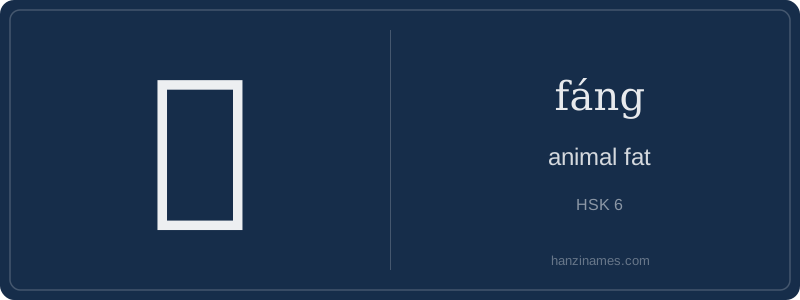
In modern Chinese, 肪 appears almost exclusively in technical, medical, or nutritional contexts—not in daily casual speech. It’s found in terms like 皮下脂肪 (píxià zhīfáng, 'subcutaneous fat') and in public health campaigns discussing obesity (e.g., '内脏脂肪超标'—excess visceral fat). It also appears in food labeling regulations (GB 28050) where '脂肪' must be listed per 100g. Historically, it occurs in Song–Ming medical texts such as 《普济方》, describing fat’s role in pulse diagnosis and herbal oil preparations.
The character is not pictographic; its origin is purely phono-semantic. No oracle bone or bronze forms exist. Instead, picture this real-life usage: A nutritionist in Shanghai shows a patient an ultrasound image labeled '肝周脂肪' (gānzhōu zhīfáng, 'perhepatic fat') while explaining fatty liver disease—a precise, clinical application where colloquial alternatives like 油 (yóu, 'oil') or 脂 (zhī, 'lipid') would lack anatomical specificity.
Our detective work begins at the character’s radical: ⺼ (the 'flesh' or 'body' radical), which appears on the left—immediately signaling this character belongs to the domain of biology, anatomy, or organic matter. This radical is a stylized form of 肉 (ròu, 'meat'), simplified in modern script but historically pictographic, representing hanging strips of flesh. Its presence here anchors 肪 firmly in the realm of bodily substances—not abstract concepts, but tangible, physical tissue.
Now zooming in on the right side: 方 (fāng), pronounced identically to 肪 and serving as the phonetic component. In phono-semantic compound characters like this one, 方 provides the sound clue—confirming the reading fáng—while contributing no direct semantic meaning. Unlike some phonetics that evolved semantically (e.g., 青 qīng for both 'blue' and 'green'), 方 here is purely acoustic scaffolding, a common pattern in characters formed during the Qin–Han standardization era.
Tracing its evolution, 肪 does not appear in oracle bone or bronze inscriptions—it emerged later, likely during the Han dynasty or early clerical script period, when medical and agricultural texts began systematically distinguishing fat types. Its eight-stroke structure stabilized by the Tang dynasty. The character’s design reflects classical Chinese analytical thinking: separate yet integrated components—form (⺼) + sound (方)—mirroring how traditional medicine categorized fat as both material substance and functional element in bodily balance.
Example Sentences
Common Compounds
Similar Characters — Don't Mix These Up
Your First Step into Chinese Culture: Get a Chinese Name
Every journey into Chinese begins with a name. Use our free Chinese name generator to create a meaningful, personalized Chinese name that fits you perfectly.
Get My Chinese Name →