肺
Character Story & Explanation
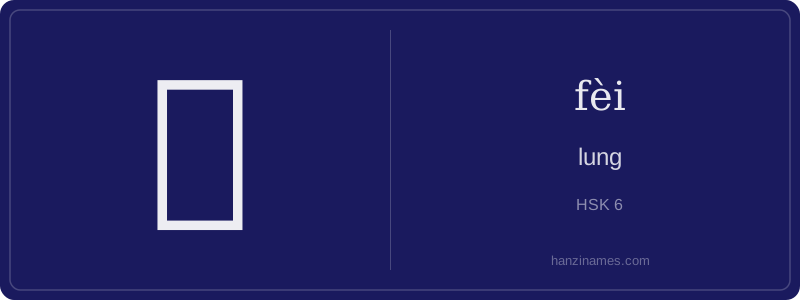
In daily life, 肺 is ubiquitous in health contexts: doctors diagnose fèi yán (pneumonia), smokers are warned about fèi bìng (lung disease), and during pandemic years, phrases like 'fèi gōng néng' (lung function) appeared constantly in public health notices. The idiom 'fèi fù zhī yán' (words from the heart and lungs) metaphorically denotes sincere, heartfelt speech—reflecting the ancient association of lungs with breath and authenticity in classical texts like the Shuowen Jiezi.
The character has no verified pictographic origin—it does not resemble lungs. Its form is purely phono-semantic: ⺼ signals ‘body tissue’, and 市 (now read fèi) provides approximate sound. Modern learners encounter it most often on hospital signs, TCM prescriptions, or air quality alerts mentioning 'fèi hǎi' (lung damage) from pollution.
Our detective begins in the Han dynasty (206 BCE–220 CE), where 肺 first appears in medical texts like the Huangdi Neijing (Yellow Emperor’s Inner Canon)—the foundational work of Traditional Chinese Medicine. The character was already standardized by then, composed of the ‘flesh’ radical ⺼ (indicating a body part) and the phonetic component 市 (shì, later evolving to fèi via sound shift). This structure reflects the ancient Chinese understanding: organs were classified not just anatomically but by their functional role in qi and blood circulation.
Zooming in on the radical: ⺼—a variant of 月 (moon), used here as ‘flesh’—appears in nearly all characters for internal organs (e.g., 肝 liver, 肾 kidney). It signals embodiment, physiology, and vitality—not celestial timekeeping. Meanwhile, the right side 市 once represented a marketplace, but its role here is purely phonetic; over centuries, pronunciation drifted from *šiᴇH* (Middle Chinese) to modern fèi due to tonal evolution and dialectal influence.
Our detective finds no oracle bone or bronze script forms of 肺—unlike more ancient characters such as 日 (sun) or 木 (tree). Its earliest confirmed form is in clerical script (lìshū) on Han bamboo slips. That absence isn’t mysterious—it simply means lungs weren’t graphically encoded in early ritual inscriptions. Instead, they entered writing when medicine became systematized. Thus, 肺 is a ‘scientific loan character’: born not from pictorial observation, but from clinical taxonomy and phonetic borrowing.
Example Sentences
Common Compounds
Similar Characters — Don't Mix These Up
Your First Step into Chinese Culture: Get a Chinese Name
Every journey into Chinese begins with a name. Use our free Chinese name generator to create a meaningful, personalized Chinese name that fits you perfectly.
Get My Chinese Name →