脉
Character Story & Explanation
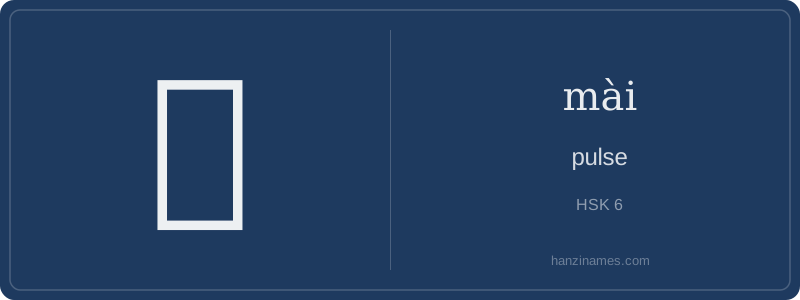
In daily life, 脉 is most commonly used in medical and metaphorical contexts. Clinically, it’s central to TCM diagnosis—practitioners assess up to 28 pulse qualities (e.g., wiry, slippery, deep). Idiomatically, 脉 is essential in phrases like ‘把握脉搏’ (bǎwò mài bó, 'grasp the pulse')—used in politics, economics, and media to mean 'understand the underlying trend.' Historically, the earliest verified usage appears in the *Huangdi Neijing* (c. 3rd century BCE), which systematically classifies pulse types by position and quality.
The character’s form is not pictographic but phono-semantic: ⺼ (flesh radical) signals bodily relevance; the phonetic component 永 (yǒng) approximates pronunciation and subtly reinforces the idea of enduring flow—though its original oracle-bone shape depicted water flowing from a source, later abstracted. No verified pre-Qin pictograph of veins exists; instead, 脉 emerged as a standardized compound during the Warring States period to denote vascular pathways.
Imagine walking into a traditional Chinese medicine clinic in Chengdu, where the air carries the scent of aged herbs and warm ginger tea. An elderly practitioner gently places three fingers on your wrist—not to check time, but to feel the subtle rhythm beneath your skin: the *mài*, or pulse. In TCM, this isn’t just heartbeat—it’s a dynamic map of organ health, qi flow, and emotional balance. Each variation in speed, depth, or tension tells a story older than written records.
The character 脉 (mài) embodies this profound connection between body and cosmos. Its left side, ⺼ (the ‘flesh’ radical), roots it in the physical—blood vessels threading through muscle and tissue. The right side, 永 (yǒng, originally meaning ‘eternal flow’), evokes continuity, like rivers feeding life. Together, they encode an ancient insight: circulation is not mechanical plumbing, but vital, rhythmic lifeforce.
Today, 脉 appears far beyond clinics—in tech startups naming AI 'pulse-check' dashboards, in literature describing a city’s 'cultural pulse', and even in metro announcements: 'Next stop: Xidan—heart of Beijing’s commercial pulse.' It bridges millennia: from acupuncture texts carved on bamboo slips during the Han Dynasty to real-time health apps analyzing wrist-worn pulse data. This one character pulses with history, science, and poetry.
Example Sentences
Common Compounds
Similar Characters — Don't Mix These Up
Your First Step into Chinese Culture: Get a Chinese Name
Every journey into Chinese begins with a name. Use our free Chinese name generator to create a meaningful, personalized Chinese name that fits you perfectly.
Get My Chinese Name →