肿
Character Story & Explanation
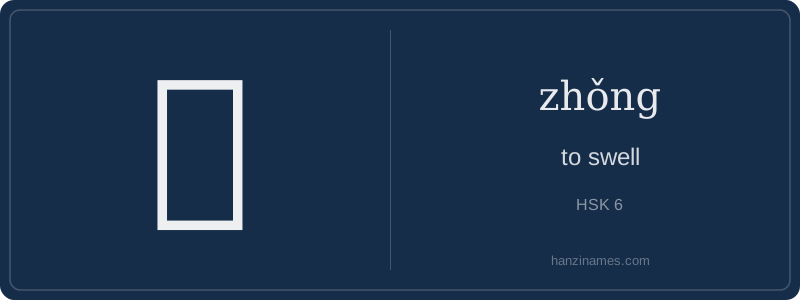
In daily life, 肿 is most commonly heard in clinics, pharmacies, and home remedies — e.g., ‘眼睛肿了’ (yǎnjiing zhǒng le, 'my eyes are swollen') after allergies or crying. It appears in HSK-6 vocabulary lists as a key term for health and body descriptions. Historically, it features in the Tang-era Qian Jin Yao Fang (Essential Prescriptions Worth a Thousand Gold), diagnosing ‘脚肿’ (jiǎo zhǒng, leg edema) as a sign of kidney or heart imbalance.
The character has no verified pictographic origin (no oracle bone form exists). Instead, it’s a phono-semantic compound: ⺼ signals bodily relevance; 冫 provides phonetic approximation. Today, Chinese speakers instantly recognize it in phrases like ‘消肿药’ (xiāo zhǒng yào, anti-swelling medicine) — a staple in every household first-aid kit.
Our detective begins at the crime scene: the character 肿. At first glance, it’s a tidy 8-stroke composition — left radical ⺼ (‘flesh’ or ‘body part’), right component 冫 (‘ice’). But wait—why ice for swelling? The clue lies in ancient medical observation: swollen tissue feels cold, taut, and stiff like frost-bitten skin. Early scribes didn’t depict inflammation literally; they encoded its *sensation* — a physiological signature recognized across Han dynasty medical texts like the Shanghan Lun.
Zooming in on the radical ⺼, we confirm it’s not just decorative: over 90% of characters with this radical relate to anatomy, injury, or bodily states — think 脸 (face), 胀 (bloat), 腐 (rot). That makes 肿 a forensic match: body + perceptual cue. The ‘ice’ component 冫 isn’t about temperature alone — in classical phonetic loan usage, it often served as a sound hint (zhǒng shares phonetic kinship with 冲 chōng and 中 zhōng), anchoring pronunciation amid semantic logic.
Modern forensics confirms no oracle bone or bronze script form survives for 肿 — it first appears reliably in clerical script (Lìshū) of the Han dynasty (~206 BCE–220 CE), used in bamboo-slip medical records to document edema, insect bites, and post-surgical inflammation. Its stability over two millennia signals clinical precision: unlike poetic or vague terms, 肿 named a measurable, observable condition — making it a cornerstone of Traditional Chinese Medicine diagnostics long before Western stethoscopes existed.
Example Sentences
Common Compounds
Similar Characters — Don't Mix These Up
Your First Step into Chinese Culture: Get a Chinese Name
Every journey into Chinese begins with a name. Use our free Chinese name generator to create a meaningful, personalized Chinese name that fits you perfectly.
Get My Chinese Name →