臂
Character Story & Explanation
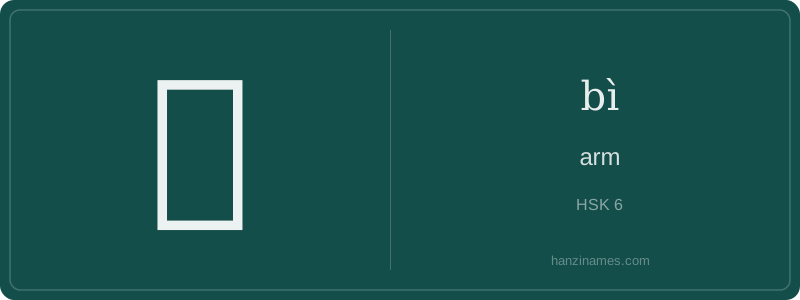
臂 is commonly used in modern Chinese in medical terminology (e.g., 臂丛神经 bìcóng shénjīng, 'brachial plexus'), martial arts manuals (e.g., 垂臂立身 chuí bì lìshēn, 'stand upright with arms hanging'), and standardized phrases like 振臂高呼 (zhèn bì gāo hū, 'raise one’s arm high to call out'—a set idiom meaning 'to rally people publicly'). It also appears in historical military texts: the *Records of the Grand Historian* (Shǐjì) uses 臂 to describe soldiers’ limbs in formation drills, confirming its longstanding anatomical function.
The character evolved from seal script, where it combined the flesh radical ⺼ with 埤 (bì, a phonetic component now obsolete), not a pictograph. No oracle bone or bronze inscription form survives—its earliest attested use is in Warring States bamboo slips (4th c. BCE), showing a consistent structure emphasizing bodily form over visual depiction. Today, Chinese learners encounter 臂 mainly in textbooks, hospital signage, or HSK 6 reading passages—not casual speech.
The Chinese character 臂 (bì) means 'arm'—specifically the upper limb from shoulder to wrist—and belongs to HSK Level 6, reflecting its use in formal, literary, or medical contexts. Unlike English 'arm', which covers both anatomical and metaphorical uses (e.g., 'arm of the law'), 臂 is rarely used alone in modern spoken Mandarin; it appears predominantly in compound words or fixed expressions. Its radical ⺼ (‘flesh’ or ‘body’) signals its bodily association, anchoring it within the semantic field of physical anatomy.
In contrast to Western anatomical terminology—where 'arm' strictly denotes the segment between shoulder and elbow (with 'forearm' for elbow-to-wrist)—Chinese usage of 臂 encompasses the entire upper limb. This broader scope aligns with traditional Chinese medicine and martial arts texts, where 臂 frequently appears in descriptions of posture, qi flow, and movement mechanics. The character’s 17-stroke complexity underscores its late lexical development, entering common written use only after the Han dynasty.
Culturally, 臂 lacks the strong symbolic weight seen in English idioms like 'a long arm of the law' or 'arm in arm'. While English leverages 'arm' for intimacy, authority, or extension (e.g., 'arm’s length'), Chinese prefers other characters—like 臂膀 (bìbǎng, 'arm and shoulder') for support or 胳膊 (gēbo, colloquial 'arm') for everyday reference. 臂 remains largely literal and technical, appearing in academic, medical, and classical registers rather than emotive or figurative speech—a distinction rooted in Chinese linguistic pragmatism and register differentiation.
Example Sentences
Common Compounds
Similar Characters — Don't Mix These Up
Your First Step into Chinese Culture: Get a Chinese Name
Every journey into Chinese begins with a name. Use our free Chinese name generator to create a meaningful, personalized Chinese name that fits you perfectly.
Get My Chinese Name →