舶
Character Story & Explanation
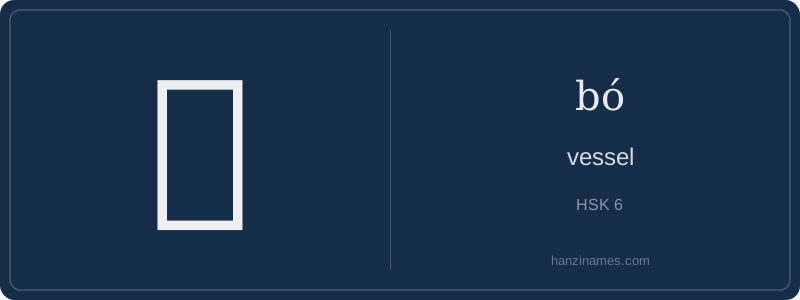
In contemporary China, 舶 appears most frequently in formal writing—customs forms, maritime regulations, economic reports, and academic journals. It’s central to the widely used term 舶来品 (bó lái pǐn), meaning 'imported goods', which carries subtle connotations of foreign origin and sometimes prestige (e.g., '舶来化妆品' — imported cosmetics). The phrase dates back to at least the Ming dynasty and remains common in media and policy discourse, such as State Council announcements on cross-border e-commerce.
The character’s structure is a clear semantic-phonetic compound: the left radical 舟 (zhōu, 'boat') signals meaning, while the right component 白 (bái) historically served as a phonetic hint—though pronunciation shifted from *bák to bó due to Middle Chinese sound evolution. No oracle-bone or bronze script forms survive; earliest attested use is in Han dynasty bamboo slips referring to official transport ships.
Imagine standing on the rain-slicked dock of Shanghai’s Waigaoqiao Port at dawn—the world’s busiest container hub. Cranes loom like steel herons over rows of colossal vessels, their hulls emblazoned with names like 'COSCO SHIPPING' and 'MAERSK'. Among shipping manifests, customs declarations, and port authority notices, the character 舶 appears repeatedly—not as a standalone word, but embedded in formal, bureaucratic, and literary contexts. It evokes maritime scale, historical trade, and China’s deep-rooted connection to seafaring commerce.
Unlike everyday words for ship (e.g., 船 chuán), 舶 carries a distinct register: it’s reserved for large, ocean-going, often foreign or cargo-carrying vessels. Its presence signals formality—seen on official documents, academic papers on maritime law, or news reports about imported goods. You won’t hear it in casual speech ('Let’s take a boat!'), but you’ll read it in headlines like '首批进口舶来品已通关' ('The first batch of imported goods has cleared customs').
This lexical precision reflects Chinese’s rich semantic layering: 船 is neutral and general; 舶 implies size, origin (often overseas), and institutional weight. Historically tied to the Maritime Silk Road, 舶 appears in Tang and Song dynasty texts describing tribute ships from Persia and Arabia docking in Guangzhou. Today, it anchors compound terms like 舶来品 (imported goods) and 航舶 (vessel), preserving that legacy in modern technical and legal language.
Example Sentences
Common Compounds
Similar Characters — Don't Mix These Up
Your First Step into Chinese Culture: Get a Chinese Name
Every journey into Chinese begins with a name. Use our free Chinese name generator to create a meaningful, personalized Chinese name that fits you perfectly.
Get My Chinese Name →