若
Character Story & Explanation
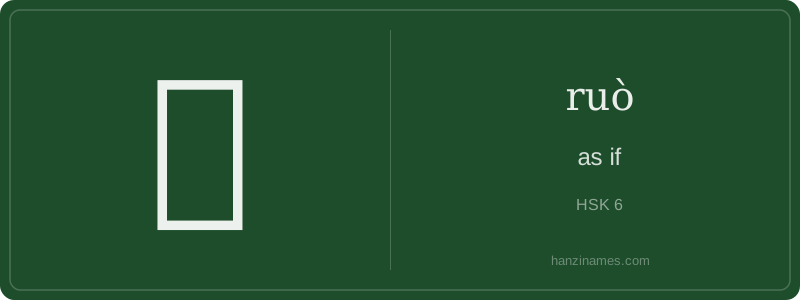
若 is widely used in formal written Chinese: legal documents, academic papers, and classical-style poetry. Common phrases include 若干 (ruògān, 'several/numerous'), 若是 (ruòshì, 'if'), and the idiom 若隐若现 (ruòyǐn ruòxiàn, 'faintly visible, intermittently appearing')—often describing distant mountains or memories. It appears in the Confucian classic *Analects* (e.g., 《论语·子路》: '君子和而不同,小人同而不和。若由也,不得其死然。') where it frames moral comparison.
The character’s earliest attested form is in bronze inscriptions of the Western Zhou (c. 1046–771 BCE), showing a person (人) beneath a roof (宀), later stylized into the modern form with 艹 on top—though this grass radical is now purely phonetic (not semantic). Its original meaning was likely 'to obey' or 'to comply', evolving by Han dynasty (206 BCE–220 CE) into 'as if' and 'if' through grammaticalization.
Imagine strolling through Chengdu’s People’s Park at dawn—bamboo leaves shimmering, elders practicing tai chi with slow, deliberate grace. A young woman sips jasmine tea, her gaze drifting to a cloud shaped like a crane. She murmurs, '若是一只仙鹤…' (ruò shì yī zhī xiānhè…)—‘If only it were a celestial crane…’ Here, 若 doesn’t mean ‘if’ in the logical sense, but evokes poetic longing: a gentle, almost wistful ‘as if’ or ‘seeming’, softening reality into possibility.
若 is a classical particle that carries literary weight—it appears more often in formal writing, legal texts, and idioms than in casual speech. Unlike the colloquial 如果 (rúguǒ), 若 preserves elegance and restraint. It signals hypotheticals with nuance: not raw conditionality, but layered perception—how something *appears*, *resembles*, or *might be imagined* under certain light, like mist over West Lake at dusk.
This subtlety makes 若 indispensable in Chinese rhetoric. In ancient texts like the *Zuo Zhuan*, 若 introduces deferential comparisons ('as though I were unworthy'). Today, judges cite 若 in verdicts ('若属实,将依法处理' — 'If proven true, will be handled according to law'), preserving its tone of measured, authoritative speculation. Its eight strokes—starting with 艹 (grass radical)—hint at organic, unfolding resemblance, not rigid logic.
Example Sentences
Common Compounds
Similar Characters — Don't Mix These Up
Your First Step into Chinese Culture: Get a Chinese Name
Every journey into Chinese begins with a name. Use our free Chinese name generator to create a meaningful, personalized Chinese name that fits you perfectly.
Get My Chinese Name →