茫
Character Story & Explanation
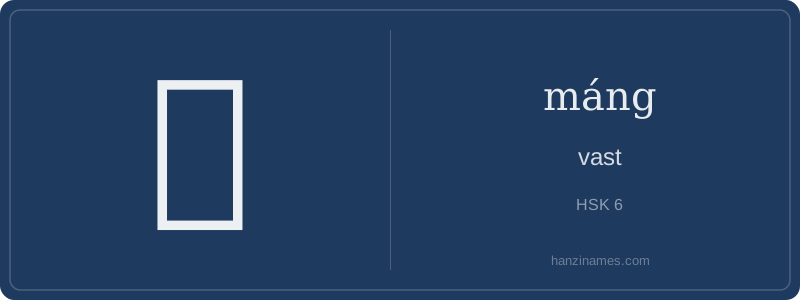
‘Máng’ appears in classical texts like the Chu Ci (3rd c. BCE) and Tang poetry to describe mist-shrouded landscapes and existential uncertainty. Today, it’s most commonly used in compound words like ‘máng rán’ (茫然), meaning ‘bewildered’ or ‘at a loss’, and ‘máng máng’ (茫茫), meaning ‘vast and boundless’. The idiom ‘máng máng rén hǎi’ (茫茫人海) — ‘vast sea of people’ — is ubiquitous in literature and daily speech to express the loneliness of anonymity in crowds.
The character’s form has no pictographic origin in oracle bone script; it first appears in seal script (c. 220 BCE) as a phonosemantic compound: 艹 (grass radical, suggesting natural expanse) + 茫 (phonetic component, now obsolete). Its modern shape reflects standardized clerical script evolution—not visual depiction, but conceptual framing of openness and scale.
‘Máng’ (茫) evokes the Chinese philosophical reverence for the boundless—whether in nature’s endless horizons or the mind’s uncharted depths. Its grass radical (艹) subtly roots this vastness in the natural world: not barren emptiness, but fertile, undulating terrain where human scale dissolves. In Daoist and Chan Buddhist thought, ‘máng’ reflects wu wei (effortless action)—a state of non-attachment to fixed boundaries, inviting humility before life’s immensity.
This character embodies a worldview that values ambiguity as wisdom, not deficiency. Unlike Western binaries of clarity vs. confusion, ‘máng’ holds both awe and uncertainty in balance—like mist over Jiangnan rivers: obscuring yet nourishing, limiting vision while deepening perception. It appears in poetry not as failure of sight, but as invitation to intuitive knowing beyond logic.
Modern usage extends this sensibility into existential reflection: students feel ‘máng rán’ facing career paths; elders speak of ‘máng máng rén shēng’—life’s vast, directionless flow. Here, ‘máng’ is neither negative nor positive, but ontological: a quiet acknowledgment that meaning emerges *within*, not at the edges, of what cannot be fully mapped—a deeply Chinese embrace of generative uncertainty.
Example Sentences
Common Compounds
Similar Characters — Don't Mix These Up
Your First Step into Chinese Culture: Get a Chinese Name
Every journey into Chinese begins with a name. Use our free Chinese name generator to create a meaningful, personalized Chinese name that fits you perfectly.
Get My Chinese Name →