萌
Character Story & Explanation
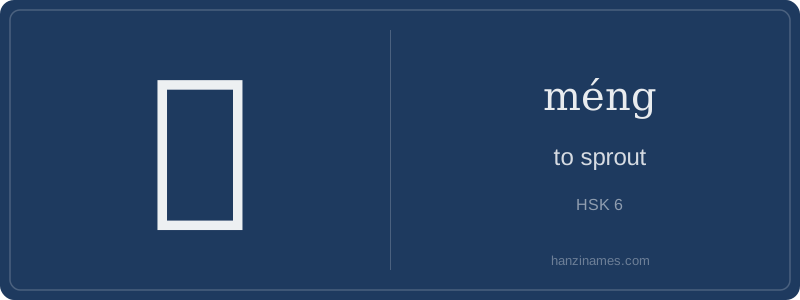
Historically, 萌 appears in classical texts like the Book of Rites (Lǐjì) and Han dynasty agricultural records, consistently meaning 'to sprout' or 'to begin to appear'. It’s used in idioms like ‘萌芽’ (méngyá, 'germ' or 'incipient stage') — still common in academic and political discourse today (e.g., ‘思想萌芽’, 'the萌芽 of a new ideology'). In modern daily life, it’s widely used in ecological journalism ('植被萌发', 'vegetation sprouting') and education materials about plant science.
The character’s form is well-documented: the top 艹 is the grass radical; the bottom 明 (míng, 'bright') is phonetic but also subtly evokes clarity and emergence — a documented semantic-phonetic compound from the Warring States period (475–221 BCE). No oracle-bone version survives, but bronze inscriptions confirm its early use in agrarian contexts.
Hi students! Let’s explore 萌 (méng), a lovely character that literally means 'to sprout' or 'to bud' — like a tiny green shoot pushing through soil in spring. It’s built with the grass radical 艹 on top, showing its connection to plants and growth. Though simple in meaning, it carries deep natural imagery: life beginning quietly, gently, full of potential. This idea of tender emergence is central to how Chinese speakers understand renewal and new beginnings.
Don’t confuse 萌 with just 'cute' — that’s a modern slang extension! Its core meaning remains botanical and classical. You’ll find it in ancient texts describing seasonal change, agricultural cycles, and even philosophical metaphors for moral awakening. Understanding this root helps you grasp both traditional usage and why it later evolved into internet slang — because something 'cute' feels similarly fresh, innocent, and newly unfolding.
As an HSK Level 6 character, 萌 appears in advanced reading, especially in literary or formal contexts. While beginners may first encounter it online as 'moe' (Japanese loan-influence), your goal is to anchor it in its original meaning: life emerging. Practice writing it slowly — 11 strokes, starting with the grass head — and remember: every stroke reflects growth, not just grammar!
Example Sentences
Common Compounds
Similar Characters — Don't Mix These Up
Your First Step into Chinese Culture: Get a Chinese Name
Every journey into Chinese begins with a name. Use our free Chinese name generator to create a meaningful, personalized Chinese name that fits you perfectly.
Get My Chinese Name →