董
Character Story & Explanation
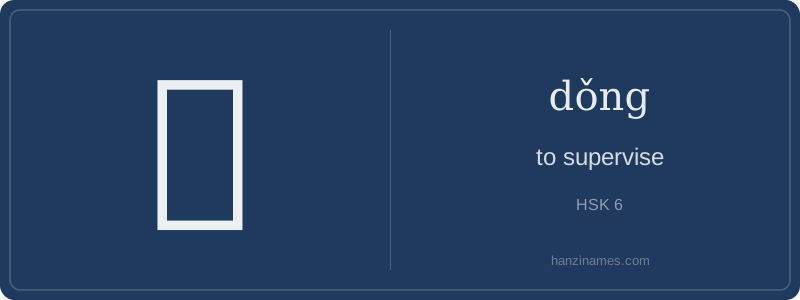
董 is most commonly used today in formal titles and institutions — especially in business and governance. The term 董事 (dǒngshì, 'director') appears in nearly every Chinese company’s official name (e.g., 董事长 dǒngshìzhǎng, 'chairman'), and all publicly listed firms in China must have a board of directors (董事会, dǒngshìhuì). It also appears in historical records: during the Han Dynasty, the title 董正 (dǒngzhèng) referred to officials who supervised ritual correctness and bureaucratic integrity.
The character’s earliest documented form appears in seal script (c. 3rd century BCE), where it combines 艸 (an early form of 艹) and 重. While 艹 suggests plant-related origins, scholars agree this is a phonetic simplification — the core semantic idea comes from 重 ('weighty responsibility'), reflecting authoritative oversight. No oracle-bone inscriptions of 董 are confirmed; its usage solidified in administrative texts from the Warring States period onward.
Hi students! Let’s learn 董 (dǒng) — a character meaning 'to supervise' or 'to manage'. Though it looks like it might relate to plants (because of the 艹 grass radical), it’s actually a phonosemantic compound: the top part (艹) is a simplified historical form, and the bottom part (重) means 'heavy' or 'weighty', suggesting seriousness and responsibility in oversight. This character appears mostly in formal or administrative contexts — not everyday casual speech.
Don’t confuse 董 with similar-looking characters like 懂 (understand) — they sound identical but have completely different meanings and origins. Pronunciation is dǒng (third tone): start low, dip down, then rise slightly. Practice saying it while thinking of a manager checking reports — that mental image helps anchor the meaning.
At HSK Level 6, 董 signals advanced vocabulary. You’ll encounter it in business texts, news about corporate governance, or official documents. It rarely stands alone — usually appears in compounds like 董事 (director) or 监督 (supervise). Writing it requires careful attention: 12 strokes, starting with the grass radical on top, followed by the complex 重 component below. Mastering it builds confidence for high-level reading!
Example Sentences
Common Compounds
Similar Characters — Don't Mix These Up
Your First Step into Chinese Culture: Get a Chinese Name
Every journey into Chinese begins with a name. Use our free Chinese name generator to create a meaningful, personalized Chinese name that fits you perfectly.
Get My Chinese Name →