蔽
Character Story & Explanation
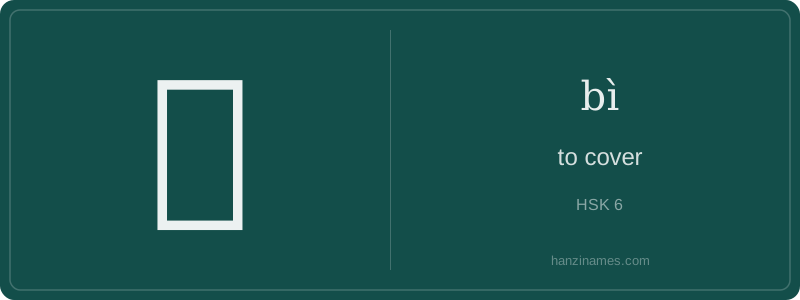
蔽 is most famously used in the idiom 一叶障目,不见泰山 (yī yè zhàng mù, bù jiàn tài shān)—'a single leaf blocks the eye, obscuring Mount Tai'—a Han dynasty-originating parable warning against narrow-mindedness. It appears in classical texts like the *Zuo Zhuan* and *Mencius* to describe political deception or self-deception. Modern usage includes formal contexts like 蔽塞 (bì sè, 'to obstruct') in legal or media discourse.
The character evolved from seal script, where the top 艹 clearly represents vegetation, and the bottom 敝 (bì, 'worn-out, shabby') conveys deterioration through coverage—documented in *Shuōwén Jiězì* (121 CE) as 'to cover so thoroughly that function is impaired'. No oracle-bone form survives, but its structure consistently signals organic obstruction.
At first glance, 蔽 means 'to cover'—but in the Chinese worldview, covering is never neutral. It implies concealment, obstruction, or even moral blindness. Unlike English’s passive 'cover', 蔽 carries agency and consequence: something vital—truth, insight, virtue—is actively obscured. This reflects a deep Confucian concern with clarity of perception and sincerity of intent: to be 蔽 is to be ethically compromised, not merely physically shaded.
The character’s grass radical (艹) hints at organic, pervasive growth—like vines smothering light—not a rigid barrier. This botanical metaphor reveals a worldview where obstruction arises naturally from unchecked conditions: ignorance spreads like weeds, bias takes root silently. Thus, 蔽 is less about force and more about insidious accumulation—echoing Daoist warnings about how small distortions compound into profound delusion.
In classical texts like the *Analects*, 蔽 appears in ethical diagnoses: 'To be blinded by anger' (忿蔽) or 'blinded by profit' (利蔽). Here, covering isn’t physical—it’s cognitive and moral. The Chinese tradition treats perception as relational and fragile; truth requires constant cultivation, lest it be 蔽 by desire, haste, or prejudice. So 蔽 is not just a verb—it’s a diagnostic term for spiritual vulnerability, urging vigilance over one’s inner landscape.
Example Sentences
Common Compounds
Similar Characters — Don't Mix These Up
Your First Step into Chinese Culture: Get a Chinese Name
Every journey into Chinese begins with a name. Use our free Chinese name generator to create a meaningful, personalized Chinese name that fits you perfectly.
Get My Chinese Name →