蕴
Character Story & Explanation
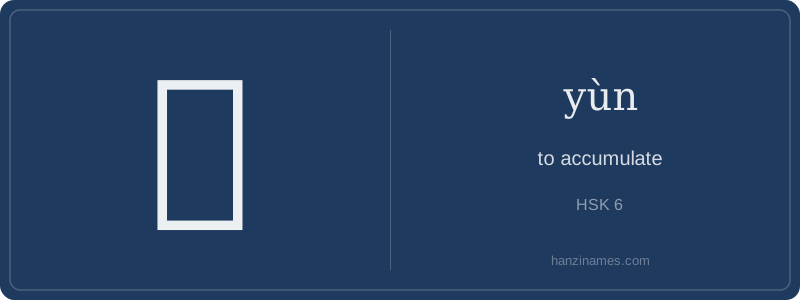
蕴 is widely used in modern Chinese academic, artistic, and political discourse. It appears in official documents (e.g., '文化蕴涵'—cultural connotations), literary criticism ('意蕴深厚'—profound artistic implication), and science journalism ('技术蕴藏量'—technical reserve capacity). A well-documented idiom is 意蕴丰富 (yìyùn fēngfù), meaning 'rich in implied meaning', frequently cited in textbook analyses of classical poetry and film reviews.
The character evolved from seal script (c. 3rd c. BCE), where its top component 艹 (grass radical) signified plant-like growth or natural emergence, and the bottom part 貫 (guàn) originally depicted a string of coins—symbolizing continuity and accumulation. By Han dynasty texts, 蕴 had stabilized in form and meaning, consistently used in philosophical works like the *Huainanzi* to describe the gathering of vital forces (qi) and moral virtues.
The Chinese character 蕴 (yùn) conveys the idea of accumulation—not merely physical piling up, but the subtle, often invisible gathering of qualities, energy, or meaning over time. Unlike English verbs like 'store' or 'collect', which emphasize intention and action, 蕴 suggests organic, internalized buildup: knowledge accumulated through reflection, cultural essence embedded in tradition, or emotions held beneath the surface. It appears frequently in formal, literary, and philosophical contexts, especially when describing latent potential or deeply rooted substance.
In classical Chinese thought, 蕴 reflects Daoist and Buddhist notions of concealed vitality—like qi coiled within the body or wisdom ripening in silence. Western equivalents such as 'latent', 'inherent', or 'embodied' come close, but lack its active verbal force: 蕴 is not static possession; it’s a dynamic process of nurturing and containment. This nuance aligns more with Greek *dynamis* (potentiality) than Latin *depositum* (deposit), emphasizing growth-in-waiting rather than inert storage.
Comparatively, English relies on compound phrases ('richly layered', 'deeply embedded') to approximate what 蕴 expresses in a single syllable. German *anhäufen* (to pile up) or French *accumuler* carry similar denotations but miss the poetic resonance of concealment and refinement. In translation, choosing 'to accumulate' risks oversimplification—yet it remains the most functional lexical anchor for learners, especially at HSK 6 where precision meets abstraction.
Example Sentences
Common Compounds
Similar Characters — Don't Mix These Up
Your First Step into Chinese Culture: Get a Chinese Name
Every journey into Chinese begins with a name. Use our free Chinese name generator to create a meaningful, personalized Chinese name that fits you perfectly.
Get My Chinese Name →