虏
Character Story & Explanation
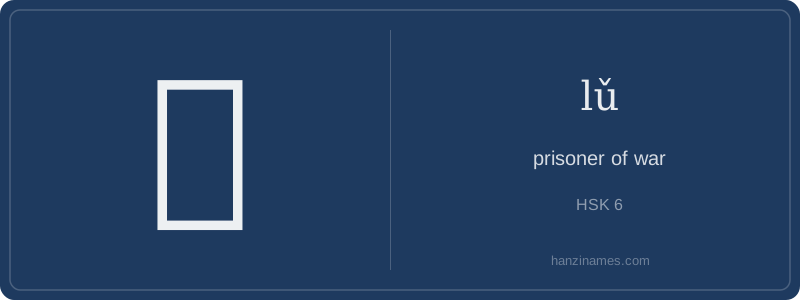
虏 is virtually absent from contemporary spoken Chinese and rarely appears outside formal historical writing, academic texts, or classical poetry. It appears in fixed phrases like ‘俘虏’ (fúlǔ, ‘captive’)—though even there, 俘 dominates colloquially. Historically, it was used in official dynastic histories (e.g., Records of the Grand Historian) to denote battlefield captives, often paired with verbs like ‘获虏’ (huò lǔ, ‘to seize prisoners’). Modern usage is almost exclusively literary or rhetorical, e.g., in essays on national sovereignty or wartime memory.
The character’s seal-script origin shows a tiger-head radical (虍) combined with a simplified form of 卢 (lú), serving as a phonetic loan. No pictographic sun/moon/tree derivation exists—it’s a phono-semantic compound, standardized by the Qin dynasty’s script unification. Today, Chinese learners encounter it mainly in HSK 6 reading passages about ancient warfare or in idioms like ‘虏使’ (lǔshǐ, ‘envoy of the captive state’), though such terms are archaic and context-dependent.
As an archaeologist brushing dust from a Han dynasty bamboo slip, I find 虜 etched in crisp clerical script—its form a stark relic of ancient warfare. The radical 虍 (tiger) isn’t decorative: it signals danger, ferocity, and the predatory logic of capture. The right side, 男 (nán, 'man') minus its top stroke and fused with 丿 and 乚, evolved into 卢—here not 'Lu' the place, but a phonetic component hinting at *lǔ*. This character never meant 'slave' generically; it specifically denoted enemy combatants seized in battle—status-bound, politically charged, and ritually documented in military reports.
The bronze inscriptions of the Warring States period reveal 虏 as a bureaucratic term: tallying captives was essential for merit rewards, tribute records, and ancestral temple announcements. Excavated Qin legal texts (e.g., Shuihudi slips) treat 虏 as juridically distinct—captured enemies could be conscripted, enslaved, or executed, but their status was legally codified, unlike domestic servants. The character’s eight strokes encode this precision: no flourish, only function—each stroke a line in a ledger of conquest.
In Tang steles and Song historiography, 虏 acquires moral weight—used pejoratively for northern nomadic adversaries (e.g., ‘the Xiongnu虏’), reflecting Sinocentric worldview. Yet paradoxically, captured Han soldiers sometimes became 虏 themselves when defeated—proving the term was situational, not ethnic. Its survival into modern Chinese is rare and literary; today, it surfaces only in historical discourse or classical allusions, preserved like a sealed jar of fermented grain—potent, aged, and deliberately uncorked only for gravity.
Example Sentences
Common Compounds
Similar Characters — Don't Mix These Up
Your First Step into Chinese Culture: Get a Chinese Name
Every journey into Chinese begins with a name. Use our free Chinese name generator to create a meaningful, personalized Chinese name that fits you perfectly.
Get My Chinese Name →