袖
Character Story & Explanation
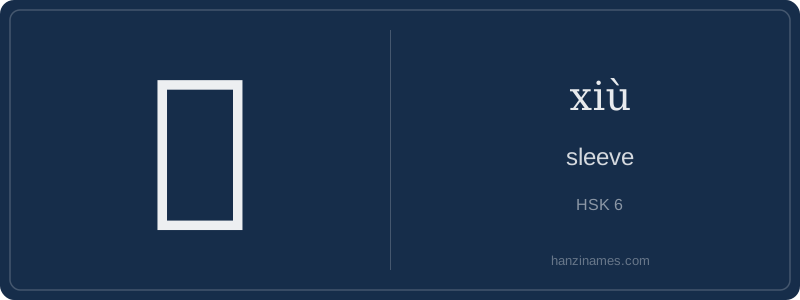
袖 is widely used in modern Chinese for clothing items (e.g., 长袖 'long sleeve', 短袖 'short sleeve') and appears in idioms like 拂袖而去 ('to leave in indignation') and 袖手旁观 ('to stand by with folded sleeves' — i.e., to remain passive). Historically, during the Han and Ming dynasties, officials wore wide-sleeved robes, and sleeve gestures carried social meaning — documented in texts like the Rites of Zhou and Ming-era etiquette manuals.
The character evolved from seal script, where it clearly depicted a garment (radical 衤) with a hand-like element (originally 又, later stylized). It is *not* a pictograph of a sleeve itself, but a semantic-phonetic compound — 衤 for meaning, 又 for approximate ancient pronunciation. No oracle bone form survives; earliest attestation is in Warring States bamboo slips.
Hi students! Let’s look at the character 袖 (xiù), which means 'sleeve' — the part of a shirt, robe, or jacket that covers your arm. It’s a Level 6 HSK character, so it appears in advanced vocabulary, but its meaning is very concrete and visual. Notice the left side is 衤 (the 'clothing' radical), which tells us this character relates to garments — just like 衣 (yī, 'clothing') and 裤 (kù, 'pants'). This radical helps you guess meaning even if you don’t know the full character yet.
The right side is 又 (yòu), which originally meant 'again' or 'also', but here it serves mainly as a phonetic hint — though pronunciation has shifted over time (xiù doesn’t sound exactly like yòu, but ancient forms were closer). Don’t worry about memorizing historical sound shifts yet — focus instead on recognizing the clothing radical + 又 shape. Practice writing it slowly: 10 strokes, starting with the radical on the left, then 又 on the right.
袖 appears often in formal, literary, or idiomatic contexts — not just for describing clothes, but symbolically too. For example, in classical poetry or historical dramas, phrases like ‘拂袖而去’ (fú xiù ér qù) — 'to flick one’s sleeve and leave' — express dignified anger or dismissal. That gesture was culturally meaningful in imperial China: sleeves were long and wide, so flicking them signaled strong emotion without shouting. Understanding this helps you see how language and culture intertwine!
Example Sentences
Common Compounds
Similar Characters — Don't Mix These Up
Your First Step into Chinese Culture: Get a Chinese Name
Every journey into Chinese begins with a name. Use our free Chinese name generator to create a meaningful, personalized Chinese name that fits you perfectly.
Get My Chinese Name →