讯
Character Story & Explanation
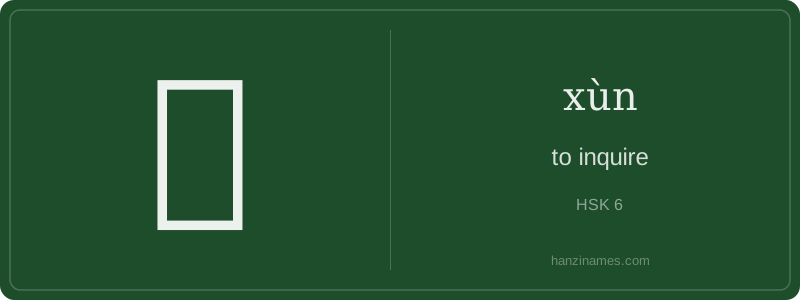
讯 appears frequently in formal and official contexts across contemporary China: police issue '讯问笔录' (xùnwèn bǐlù, interrogation records); state media headlines use '最新讯息' (zuìxīn xùnxī, latest information); and government notices cite '权威讯息' (quánwēi xùnxī, authoritative information). It's central to HSK 6 vocabulary due to its role in advanced reading comprehension of administrative, legal, and journalistic texts. A well-documented phrase is '讯问权' (xùnwèn quán)—the legally defined 'right to interrogate' under China’s Criminal Procedure Law.
The character’s modern form derives from the traditional 訊, with the left-side 言 (speech) simplified to 讠. The right component 卂 (xùn) is phonetic and historically evoked 'swift movement'—suggesting prompt, purposeful speech. No oracle-bone or bronze inscription evidence exists for this specific character; it first appears reliably in Han dynasty clerical script as a standardized term for official inquiry.
The Chinese character 讯 (xùn) is a concise, five-stroke glyph belonging to the 'speech' radical (讠), signaling its semantic connection to verbal communication. Historically, it evolved from the older form 訊 in seal script, where the left side (言) denoted speech and the right (卂) suggested swiftness or urgency—reflecting how inquiries often carry immediacy or purpose. Though now simplified, its core function remains tied to formal or official questioning.
In modern usage, 讯 carries a tone of structured, authoritative inquiry—not casual curiosity but deliberate information-seeking, often in institutional contexts like law enforcement, journalism, or diplomacy. Unlike English 'ask', which is neutral and ubiquitous, 讯 implies intent, method, and sometimes power dynamics: a police officer 讯问 (xùnwèn) a suspect, not just 'asks' them. This nuance reflects Confucian-influenced values around propriety, hierarchy, and the social weight of spoken words.
Western equivalents like 'interrogate', 'question', or 'inquire' come closest—but each misses part of 讯’s spectrum. 'Interrogate' overemphasizes coercion; 'inquire' feels too polite and bureaucratic; 'question' lacks the lexical specificity of official procedure. In contrast, 讯 sits precisely at the intersection of duty, clarity, and formality—making it indispensable in legal documents, news headlines (如:讯息), and public announcements where precision and authority matter.
Example Sentences
Common Compounds
Similar Characters — Don't Mix These Up
Your First Step into Chinese Culture: Get a Chinese Name
Every journey into Chinese begins with a name. Use our free Chinese name generator to create a meaningful, personalized Chinese name that fits you perfectly.
Get My Chinese Name →