诞
Character Story & Explanation
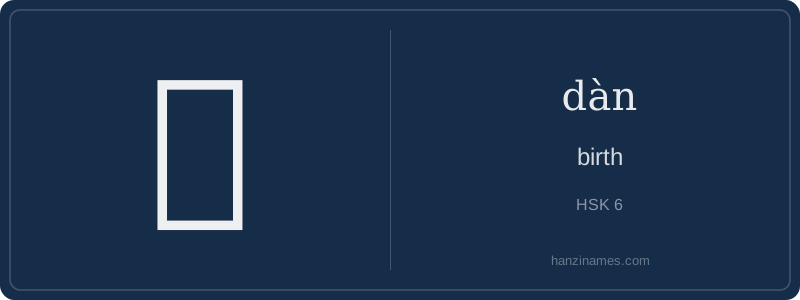
诞 is widely used in formal and commemorative contexts across Chinese-speaking societies: it appears on official banners for National Day celebrations (国庆诞辰 guóqìng dànchén, 'founding anniversary'), in temple inscriptions honoring Confucius’s birthday (孔子诞辰 Kǒngzǐ dànchén), and universally in 圣诞节 shèngdànjié ('Christmas'). The phrase 诞生 (dànshēng) is standard in news headlines announcing major achievements—e.g., 'the birth of China’s first Mars rover.' Historically, 诞 was employed in imperial edicts and stele inscriptions to mark dynastic inaugurations.
The character’s form evolved from seal script; its left side 讠 (speech radical) reflects its ancient association with declaring or heralding a significant birth, while the right component 延 (yán) originally suggested 'prolongation' but here functions phonetically. No oracle-bone or bronze inscription evidence exists for 诞—it first appears reliably in Han dynasty texts, confirming its later, literate origin tied to ritual proclamation rather than pictographic depiction.
The Chinese character 诞 (dàn) primarily signifies 'birth'—especially in formal, literary, or ceremonial contexts. Unlike the neutral English word 'birth,' 诞 carries elevated connotations: it’s reserved for momentous beginnings, such as the birth of sages, founders, or deities. It rarely appears in clinical or biological discussions (where 出生 chūshēng is used instead), reflecting a cultural emphasis on significance over physiology.
In classical and modern usage, 诞 frequently appears in honorific compounds like 圣诞 (shèngdàn, 'Holy Birth' → Christmas) and 诞生 (dànshēng, 'to be born/come into being'). Its radical 讠 (speech) signals its original link to proclamation—the announcement of a momentous birth—rather than physical delivery. This underscores how Chinese semantics often embed social ritual into vocabulary.
Comparatively, Western equivalents like 'nativity' (from Latin *nativitas*) share 诞’s solemnity and religious resonance, especially in Christian contexts (e.g., Nativity scene). Yet unlike English ‘birth’—which spans medical reports, birth certificates, and slang ('a total birth!' meaning absurdity)—诞 remains strictly dignified and never colloquial or ironic. Its register is consistently elevated, aligning more with 'genesis' or 'inauguration' than with everyday 'birth.'
Example Sentences
Common Compounds
Similar Characters — Don't Mix These Up
Your First Step into Chinese Culture: Get a Chinese Name
Every journey into Chinese begins with a name. Use our free Chinese name generator to create a meaningful, personalized Chinese name that fits you perfectly.
Get My Chinese Name →