谍
Character Story & Explanation
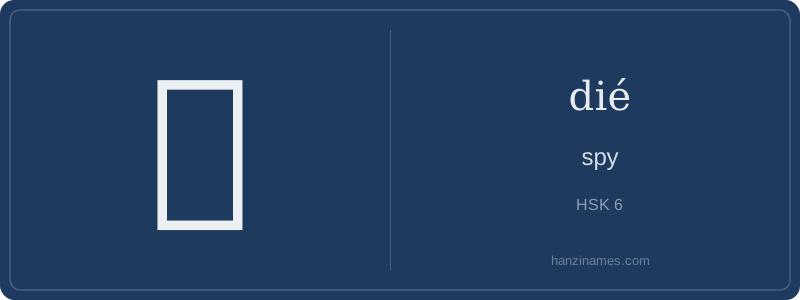
谍 is most commonly encountered in compound words like 间谍 (jiān dié, 'spy'), 反间谍 (fǎn jiān dié, 'counter-espionage'), and 国家安全局反间谍处 (State Security Bureau’s Counter-Espionage Division)—a real department under China’s Ministry of State Security. It appears in official notices, CCTV documentaries on Cold War-era intelligence operations (e.g., the 1950s ‘Liu Lian Case’), and annual reports on national security education campaigns targeting university students.
The character’s written form evolved from seal script, where the right side resembled 枻 (a boat oar), symbolizing ‘steering across borders’—a documented semantic metaphor for covert movement between domains. While the exact oracle-bone origin is unattested, its standardized structure since the Han dynasty consistently pairs speech (讠) with strategic navigation (枼/枻), reflecting how espionage hinges on controlled information flow.
The character 谍 (dié) embodies the covert, high-stakes world of intelligence gathering. Its left radical 讠 (speech radical) signals that this activity involves communication—often disguised, coded, or clandestine dialogue. The right component 枻 (yì, though here simplified to 枻-like form) historically relates to 'crossing' or 'navigation', evoking the idea of moving between worlds: friend and foe, truth and deception. This duality makes 谍 uniquely precise—it doesn’t mean ‘spy’ as a person generically, but specifically one engaged in *information-based espionage*.
In modern usage, 谍 carries strong institutional weight. It appears almost exclusively in formal contexts: state security documents, historical accounts of wartime intelligence, and official media reporting on counter-espionage cases. Unlike colloquial terms like 间谍 (jiān dié), which is more general, 谍 alone is rarely used standalone in speech—it’s literary, bureaucratic, and gravely serious. Its tone (fourth tone) mirrors its sharp, decisive connotation: no ambiguity, no hesitation.
HSK Level 6 reflects its specialized register—not everyday vocabulary, but essential for advanced learners engaging with Chinese political discourse, historical narratives, or legal texts. Mastering 谍 means understanding not just lexical meaning, but China’s conceptual framing of information sovereignty: spying isn’t romanticized; it’s treated as a boundary violation demanding systemic vigilance. That gravity is encoded in every stroke—especially the final downward stroke of the speech radical, like a sealed dossier snapping shut.
Example Sentences
Common Compounds
Similar Characters — Don't Mix These Up
Your First Step into Chinese Culture: Get a Chinese Name
Every journey into Chinese begins with a name. Use our free Chinese name generator to create a meaningful, personalized Chinese name that fits you perfectly.
Get My Chinese Name →